
Bulk Material Handling
2-Way vs 3-Way Diverter Valve: Key Differences and How to Choose the Right One

Vijay Baid
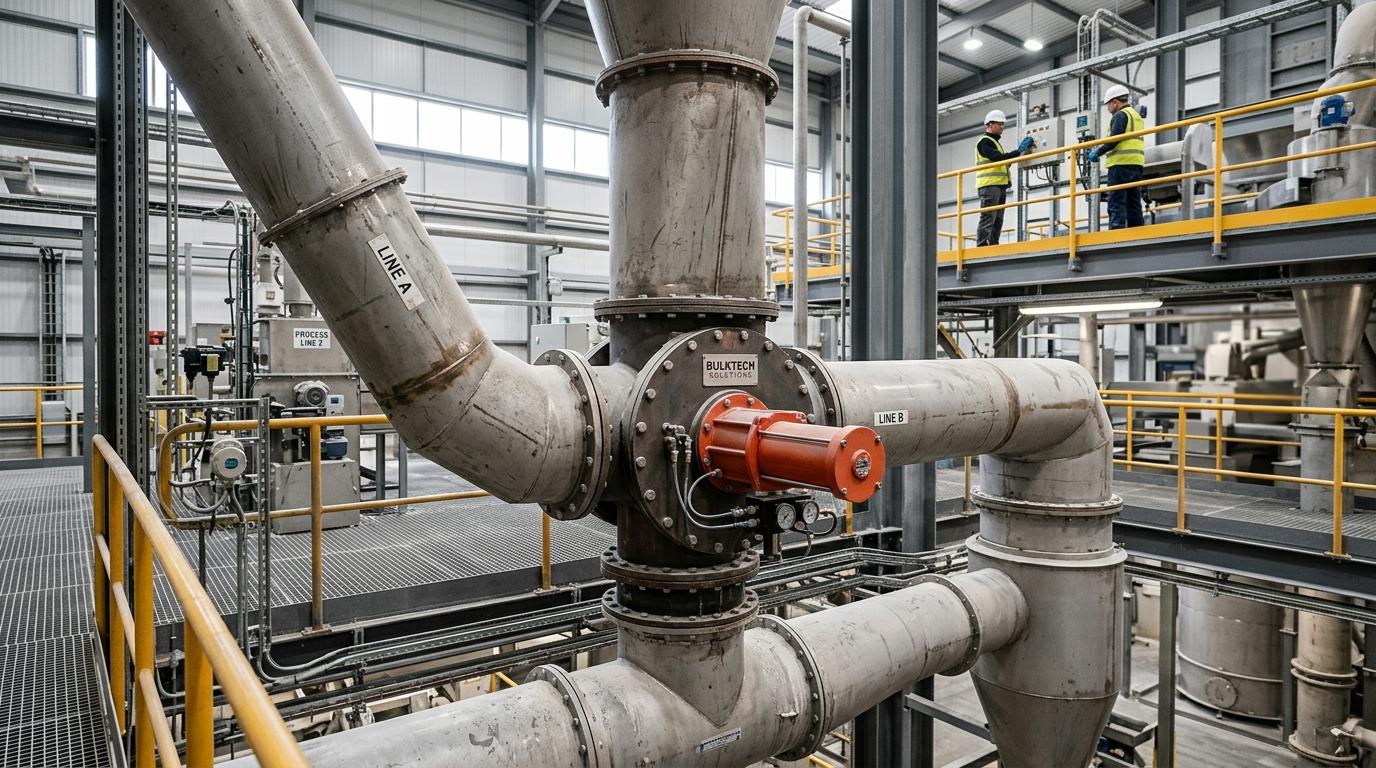
TL;DR: A 2-way diverter valve is used when one material stream needs to switch between two destinations. A 3-way diverter valve is useful when the process needs a third route, such as a bypass, reject, reclaim, or campaign-change line. The right choice depends on the actual routing duty, material type, wear, sealing needs, switching frequency, and maintenance access.
Choosing between a 2-way and 3-way diverter valve may look simple. One has two routes and the other has three. But the decision is not only about the number of outlets.
The wrong valve can lead to material buildup, leakage, excess wear, difficult maintenance, and a layout that is harder to manage. The better approach is to first understand what the process needs the valve to do.
This guide explains the difference between 2-way and 3-way diverter valves, where each one fits, and what to check before making a selection.
What Is a Diverter Valve?
A diverter valve is used to change the direction of a material stream. In a dry bulk handling system, material may need to move from one source to different destinations. For example, one material stream may need to move to different silos, conveyors, hoppers, or process lines.
For broader public guidance on conveyor-related safety around material movement, OSHA’s conveyor safety standard is a useful reference.
A diverter valve controls this routing. The basic job is simple: receive the material from one path and direct it toward the selected destination. In practical systems, this routing function often works alongside equipment such as flow control gates and slide gates to manage isolation and controlled material movement through the line. The main difference between a 2-way and 3-way diverter valve is the number of available routing paths.
What Is a 2-Way Diverter Valve?
A 2-way diverter valve sends one incoming material stream to one of two destinations. It is a straightforward solution for plants where material only needs to switch between two routes. These routes may lead to two storage silos, two conveyors, two hoppers, or two downstream processes.
For example, a cement plant may need to send cement powder to either:
Storage Silo A
Storage Silo B
The 2-way diverter allows the operator or control system to select the required route.
Why Use a 2-Way Diverter?
The main benefit is its simpler internal design.
With fewer routing paths, there are usually:
Fewer sealing points
Fewer areas where material can collect
Fewer possible wear zones
Simpler maintenance
More predictable material flow
This can be especially useful when the material is fine, abrasive, or sensitive to leakage. A 2-way diverter is often a practical choice when the plant does not need additional routing flexibility.
What Is a 3-Way Diverter Valve?
A 3-way diverter valve provides three possible routing paths for one incoming material stream. The additional route can be useful when the process needs more than two destinations.
For example, one incoming stream may need to go to:
A normal production line
A second production line
A bypass or reject line
A 3-way valve can also be used for reclaim systems, campaign changes, or applications where one source needs to serve three destinations. In layouts where the system also includes rotary air lock valves or butterfly and knife gate valves for upstream or downstream flow control, the extra route can reduce the need for additional piping and routing hardware. This can also help in plants where available space is limited.
However, the extra route also adds complexity. More routing paths can create additional sealing and wear challenges. Fine powders and abrasive materials may also collect in areas that are difficult to clean if the valve is not correctly matched to the application. That is why a 3-way diverter should not be selected simply because it offers more options.
2-Way vs 3-Way Diverter Valve: Key Differences
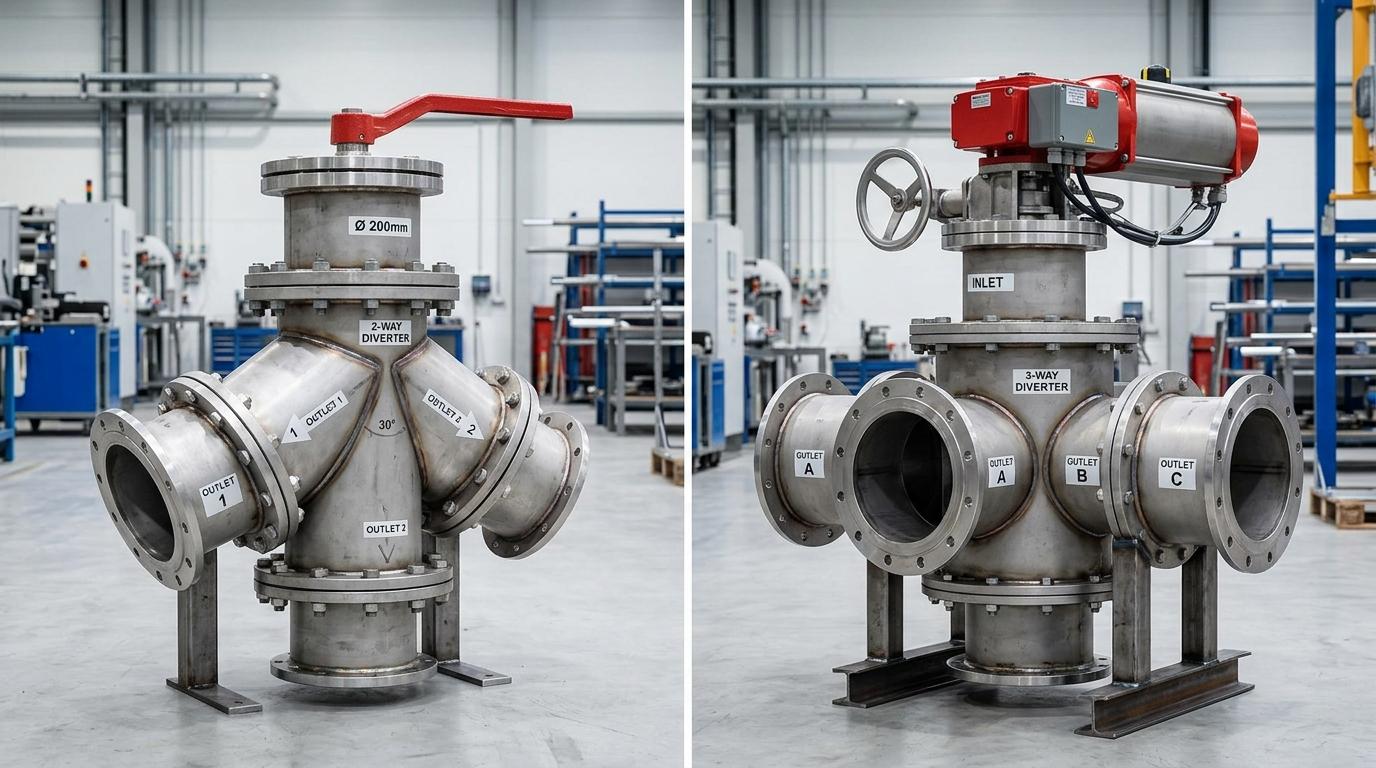
Factor | 2-Way Diverter Valve | 3-Way Diverter Valve |
|---|---|---|
Routing duty | One inlet to two destinations | One inlet to three destinations |
Internal complexity | Lower | Higher |
Sealing | Usually easier to manage | More demanding |
Wear exposure | Fewer possible wear zones | More possible wear points |
Layout flexibility | Best for simple routing | Useful when a third route is needed |
Maintenance | Usually simpler | Can require more attention |
Best fit | Two working destinations | Three real routing requirements |
The important point is that neither design is automatically right for every plant. The valve should match the actual job it needs to perform.
If you are moving from comparison to vendor evaluation, a spec sheet gives you a faster way to review design intent, routing role, and how the valve fits into a broader bulk material handling system. It is especially useful when your team needs a practical reference for technical screening and shortlisting.
The Real Question: How Many Routes Does Your Process Need?
The easiest way to start the selection is to look at the actual process. If one material stream only needs to move between two destinations, a 2-way diverter may be enough. If the process regularly needs a third route, a 3-way diverter may make more sense.
Before choosing, ask:
How many destinations are used during normal operation?
Is the third route really needed?
How often will the valve change position?
Is the material fine, abrasive, sticky, or aerated?
How important is leakage control?
Is cross-contamination a concern?
How easy is it to inspect and clean the valve?
How much maintenance access is available?
These questions help move the decision from a simple equipment comparison to an actual process-based selection.
When Should You Choose a 2-Way Diverter Valve?
A 2-way diverter is usually a good fit when the process has two clear destinations. For example, it can be used when one source alternates between:
Two storage silos
Two bins
Two process lines
Two downstream systems
It can also be useful when the plant wants to keep the system simple. A 2-way diverter may be suitable when:
The material only needs two possible routes
The material is abrasive
Fine powder leakage must be controlled
Maintenance access is limited
Simple cleaning is important
The plant wants fewer routing complications
Because the design is simpler, it can make sealing, maintenance, and material flow easier to manage.
Example
Imagine a cement handling line where cement must be sent to either Silo A or Silo B. There is no need for a third destination. Adding a 3-way valve in this case would provide an extra route that the process does not actually use. A 2-way diverter keeps the routing simple and focused on the real requirement.
When Should You Choose a 3-Way Diverter Valve?
A 3-way diverter becomes useful when the third route has a clear job. For example, a plant may need:
Normal route + alternate route + bypass route
Or:
Production line + reject line + reclaim line
In these cases, the third route is part of the operating process rather than an unused option.
A 3-way diverter may be worth considering when:
One source must serve three working destinations
A bypass route is part of normal operation
A reject route is required
Reclaim routing is required
Product campaigns require frequent routing changes
The plant wants to reduce extra routing hardware
Space is limited and a compact routing arrangement is useful
The key is simple: The third route should solve a real process problem.
If it is rarely used or only added “just in case,” the extra complexity may not provide enough value.
If your plant is actively evaluating whether a 2-way or 3-way diverter is the better fit, the right answer usually comes down to routing logic, material behavior, sealing requirements, and maintenance access. A technical review helps confirm whether the added complexity of a third path is justified before you lock in the specification.
Material Type Also Matters
The number of outlets is only one part of valve selection. The material moving through the valve can have a major effect on how the valve performs. Different materials create different operating conditions.
For example:
Fine powders can create dust leakage and sealing challenges.
Abrasive materials can increase wear on internal parts.
Sticky materials can create buildup and make cleaning harder.
Moisture-sensitive materials may need a design that reduces material hang-up.
Cement powder, fly ash, minerals, clinker, and other bulk materials may therefore require different design considerations. In many plants, the diverter is only one part of a wider conveying path that may also include air slide assemblies for powder transfer or screw conveyors for controlled bulk movement. This is why choosing a valve only by outlet count can be a mistake. The valve must also suit the material it will handle.
How Material Abrasiveness Affects the Choice
Abrasive materials can wear internal valve surfaces over time. If the valve has more routing paths, there may also be more areas exposed to material flow.
For this reason, plants handling abrasive materials should look closely at:
Internal wear zones
Wear protection
Material impact areas
Expected operating frequency
Inspection access
A simpler 2-way design may have fewer wear points when the process only needs two destinations. A 3-way valve can still work for abrasive service, but the additional route must be properly considered as part of the design.
Why Sealing Matters
Sealing becomes especially important when handling fine powders.
Poor sealing can allow material to escape from the valve. This can create:
Dust around the equipment
Product loss
Housekeeping problems
Cross-contamination
Additional maintenance work
A simpler 2-way design can make sealing easier to manage because the internal routing arrangement is less complex. A 3-way valve may require more attention to sealing because of the additional routing path and internal surfaces. In dusty systems, related equipment such as dampers and dip tubes may also play a role in controlling airflow and material movement around the process. The correct choice therefore depends on both the routing requirement and the material being handled.
Maintenance and Cleanout
Maintenance is often overlooked during equipment selection. A valve may work well on paper but become difficult to maintain once it is installed.
Before choosing a diverter, consider:
Can technicians easily reach the valve?
Can the internal areas be inspected?
Can material buildup be removed?
Can worn parts be replaced without major shutdown work?
Is there enough space around the valve for maintenance?
A 2-way diverter will generally have a simpler internal arrangement. A 3-way diverter can be more demanding because there are more routing areas to inspect and maintain. For plants where maintenance access and safe inspection practices are critical, MSHA’s conveyor systems safety guidance is a practical public reference. For plants with limited maintenance access, this difference can become important.
Common Mistakes When Selecting a Diverter Valve
Many valve problems begin with small selection mistakes.
1. Choosing a 3-Way Valve Just for Flexibility
A third route may look useful in the design stage. But if the route is not used during normal operation, it adds complexity without solving a real problem. Choose the third route only when the process needs it.
2. Ignoring Cleanout Access
Dust and bulk material can collect inside equipment. If technicians cannot easily inspect or clean the valve, routine maintenance can become difficult. Always consider access before installation.
3. Underestimating Abrasive Wear
Abrasive materials can wear internal parts faster than expected. The valve should be selected with the material's wear behavior in mind.
4. Overlooking Sealing Requirements
Fine powders can quickly expose weak sealing points. If leakage control is important, sealing should be considered during the selection stage, not after installation.
5. Designing for Layout First
A compact layout can be useful. But saving space should not come at the cost of poor flow, difficult maintenance, or excessive wear. The process duty should come first.
A Simple Selection Guide
You can use this basic rule when comparing the two options:
Choose a 2-Way Diverter Valve When:
One material stream needs two destinations.
The process is straightforward.
Simple maintenance is important.
Leakage control is important.
You want fewer routing complications.
The third route is not required.
Choose a 3-Way Diverter Valve When:
One source needs three working destinations.
A bypass route is part of the process.
A reject or reclaim route is required.
Product campaigns require flexible routing.
The third path will be used regularly.
The added complexity is justified by the process.
This decision rule is also reflected in the source material: use a 2-way valve for two working destinations and consider a 3-way valve when a genuine third routing path is required.
What Should You Check Before Final Selection?
Before ordering a diverter valve, review the complete operating condition.
1. Routing Requirement
First, confirm how many destinations the material actually needs to reach. Do not select a 3-way valve only because it provides more options.
2. Material Type
Identify whether the material is:
Fine
Abrasive
Sticky
Moisture-sensitive
Granular
The material can affect sealing, wear, buildup, and cleanout requirements.
3. Switching Frequency
A valve that changes position many times during normal operation may face different demands than one that changes position only occasionally. Make sure the design matches the expected operating cycle.
4. Leakage Sensitivity
If the material is a fine powder, leakage control may be especially important. Consider how the valve will maintain sealing during normal operation. For dust-heavy applications, the NIOSH Dust Control Handbook for Industrial Minerals Mining and Processing is a strong public reference on controlling dust exposure in conveying and processing environments.
5. Maintenance Access
Check the physical space around the valve. A valve that cannot be easily inspected or cleaned can become a maintenance problem later. The same thinking applies to surrounding equipment such as transfer chutes and belt conveyors that shape access, layout, and serviceability across the broader material handling system.
6. Wear Risk
For abrasive materials, consider how the material will interact with the internal surfaces and wear areas. These checks help ensure that the selected valve matches the real plant conditions rather than only the piping layout.
Key Takeaways
The difference between a 2-way and 3-way diverter valve is more than one extra outlet.
It affects the routing logic, internal complexity, sealing, wear, maintenance, and overall fit with the process.
A 2-way diverter valve is a practical choice when one material stream only needs to switch between two destinations.
A 3-way diverter valve becomes useful when a third route has a real operating purpose, such as bypass, reject, reclaim, or campaign-change routing.
The best selection starts with the process.
Ask how many routes are really needed, understand the material being handled, check sealing and wear requirements, and make sure maintenance teams can access the valve easily.
Choose the routing design that solves the actual plant requirement—not simply the one that offers more outlets.
Frequently asked questions
No. A 3-way diverter is only better when the process genuinely needs a third routing path. If the system only switches between two destinations, a 2-way valve is usually simpler, easier to seal, and easier to maintain.
That depends on the duty, but simpler flow paths usually help in abrasive service. A 2-way diverter often has fewer wear zones, while a 3-way design needs stronger internal wear protection if the third route is regularly used.
Yes, it can. In some layouts, a 3-way valve reduces extra pipe runs or additional routing hardware. But that space saving should still be weighed against cleanout access, sealing demands, and wear risk.
The most important factors are actual routing duty, material behavior, leakage control, maintenance access, and switching frequency. Outlet count is only the starting point.
Yes. Fine powders such as cement or fly ash usually require better sealing and smoother internal paths to reduce dust escape and contamination. That makes correct valve design especially important.