
Conveyor Troubleshooting
Conveyor Belt Tracking Problems: Complete Troubleshooting Guide for Plant Engineers

Vijay Baid
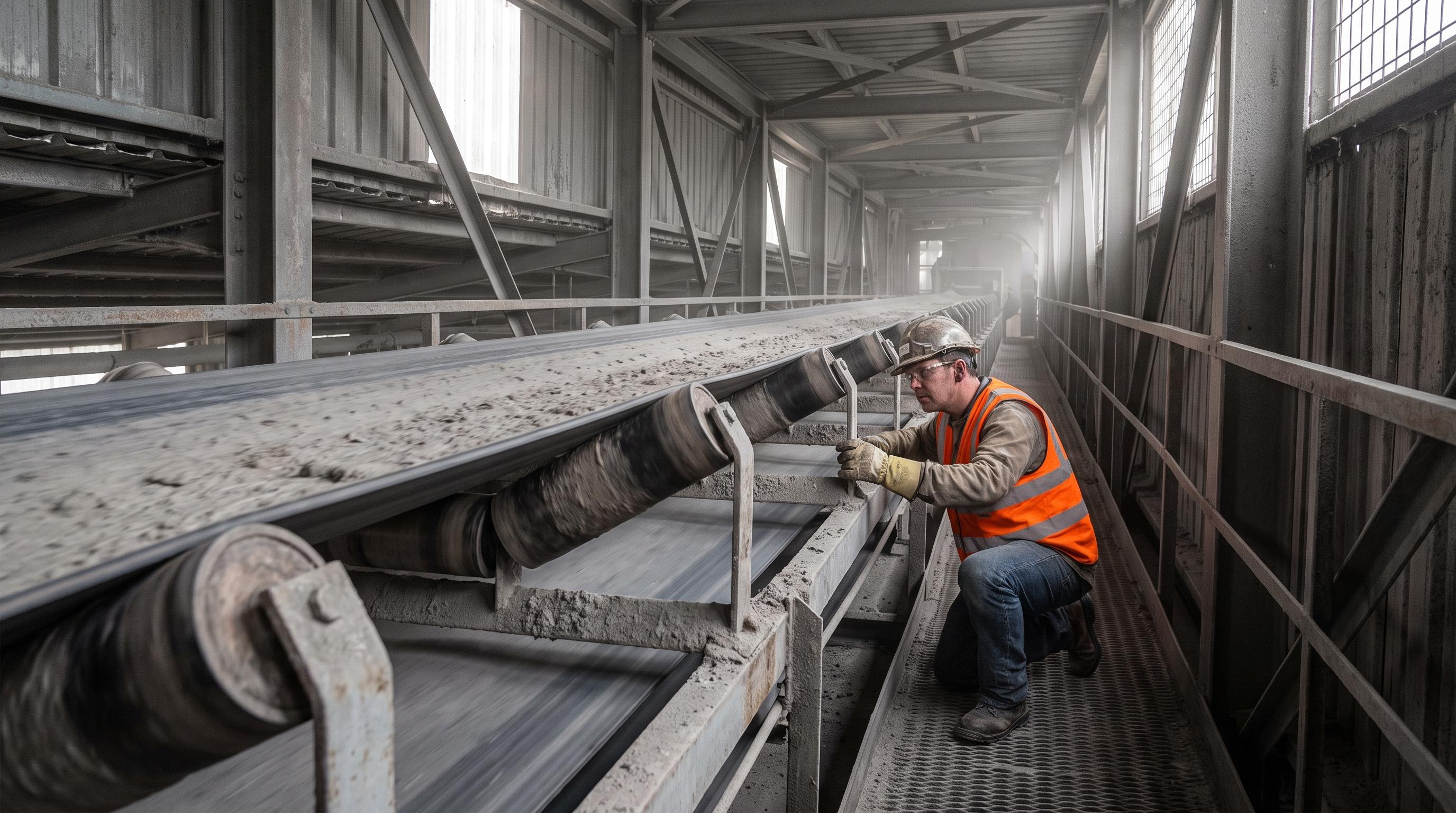
Conveyor belt tracking problems are rarely solved by adding one trainer idler and hoping for the best. A belt usually runs off-center because something is forcing it sideways: uneven loading, seized or dirty idlers, poor pulley alignment, bad tension distribution, carryback on the return side, or a twisted structure. The fastest lasting fix is to inspect the belt path zone by zone, remove build-up, check alignment, correct loading, and then use training devices only as a final control measure.
Plant engineers usually see belt mistracking first as a nuisance: edge wear, spillage near the structure, noisy rubbing, or repeated emergency stops. But a tracking problem is not a small housekeeping issue. It is an early warning that the conveyor is no longer running in its intended geometry.
In cement, mining, and bulk handling plants, that geometry matters every minute. Once the belt starts walking to one side, you get skirt leakage, return-side build-up, pulley lagging damage, idler frame wear, and more downtime for cleaning and rework. If the problem stays untreated, the belt can cut its own edges, damage the structure, or fail at the splice.
This guide is written for plant engineers, maintenance managers, and reliability teams who need a practical way to diagnose conveyor belt tracking problems and fix the real root cause.
What conveyor belt tracking problems really mean
A conveyor belt is tracking correctly when it runs centrally on the carrying side, centrally on the return side, and enters every pulley squarely. If it drifts to one side, the conveyor is telling you that a force somewhere in the system is no longer balanced.
That force may come from the loading zone, the return run, the pulleys, the belt splice, or the supporting structure. This is why plant teams should avoid the common mistake of treating mistracking as only an idler problem. Good tracking depends on the whole conveyor system, including loading, cleaning, tensioning, and alignment, which is why many engineering teams benchmark their inspections against CEMA guidance.
If you are also seeing return-side build-up, read our guide on conveyor carryback. If the issue is tied to poor roller choice or spacing, our conveyor idler selection guide is the right follow-up.
The 10 most common causes of belt mistracking
Cause | What you see | What it usually means |
|---|---|---|
Off-centre loading | Belt drifts soon after the loading point | Material is pushing the belt sideways |
Dirty or seized idlers | Sudden drift in one local zone | That zone is changing belt travel resistance |
Carryback on return idlers | Return belt wanders, especially in wet fines | Material build-up has changed roller profile |
Head or tail pulley misalignment | Belt runs off as it approaches a pulley | The belt is entering the pulley out of square |
Uneven belt tension | Tracking changes with load or startup | Tension is not distributed evenly across belt width |
Bad splice squareness | Belt tracks differently after each revolution | The splice is steering the belt sideways |
Twisted or out-of-level structure | Chronic drift in the same section | The conveyor frame is forcing a bias |
Poor transition design | Edge damage near pulleys | The belt is changing shape too quickly |
Wrong or overused trainer idlers | Temporary correction, recurring problem | The symptom is being controlled, not the cause |
Material build-up on pulleys | Belt walks at one pulley and slips | Pulley diameter has become uneven |
How to diagnose the problem without wasting a shutdown
Start with the question: Where does the belt first move off-center? That point matters more than where the damage appears. The belt may rub the structure near the head pulley while the real cause sits 20 meters upstream.
Use this sequence during a walkdown:
Check whether the empty belt tracks differently from the loaded belt. If yes, loading and tension distribution are likely involved.
Check whether the return side is cleaner than the carry side. Heavy build-up on return idlers often explains unstable tracking.
Watch belt entry into the head and tail pulleys. A belt should enter squarely, not snake into the drum.
Check idlers by hand during isolation. One seized, tilted, or eccentric idler can disturb a local section.
Inspect the splice. If the belt pulls left on one revolution and steadies on the next, the splice may be out of square.
Check frame straightness, pulley alignment, and level. A good belt cannot run straight on a twisted structure.
Practical rule: If the mistracking starts only when material is loaded, inspect the chute, loading trajectory, skirt seal pressure, and impact zone first. If it happens even with no material, start with alignment, idlers, pulleys, belt condition, and splice quality.
Root-cause decision matrix for plant engineers
If you observe this | Check this first | Why |
|---|---|---|
Belt drifts after loading point | Chute centering and material flow | Off-centre burden creates lateral force |
Return belt drifts in wet conditions | Carryback, cleaners, return rollers | Build-up changes effective roller diameter |
Belt runs off at one pulley | Pulley alignment and lagging condition | The belt follows the pulley entry geometry |
Tracking changes after splice passes | Splice squareness | An uneven splice steers the belt each cycle |
Tracking worsens with higher load | Tension, loading, transition support | Load amplifies geometry and support errors |
Engineering fixes that actually work
1. Correct the loading trajectory
The belt should be loaded centrally, at the same direction as belt travel, with minimal side impact. If material drops to one side or hits at an angle, the belt will chase the load. In cement and clinker handling, this is one of the most common causes of chronic mistracking near transfer points, and it is exactly why CEMA guidance gives so much attention to loading and transfer-point geometry.
Fix the chute first. Center the material stream. Reduce side impact. Make sure skirts do not pinch one belt edge harder than the other.
2. Clean the return side properly
Tracking cannot stay stable when return rollers are wearing a layer of hardened fines. Build-up creates a false crown and pushes the belt off-center. This is why cleaner condition matters directly to tracking, not just housekeeping.
If your plant handles sticky fines or moist material, improve belt cleaning and return protection before adding more trainer idlers. This is often the most economical fix.
A short technical reference can save hours during shutdown planning. Download the spec sheet if your team needs a faster way to compare components, layouts, and corrective options before the next maintenance window.
3. Align pulleys and structure
Head and tail pulleys must be square to the belt path. The structure must also be straight, level where intended, and free of local twist. A misaligned pulley will steer the belt no matter how many training devices you install. Because these checks happen near rotating equipment, inspections and adjustments should also follow OSHA machine guarding guidance and site isolation procedures.
When plants call for repeated tracking corrections, we often find the real issue is basic geometry: unequal frame heights, skewed pulley bearings, or a shifted loading structure after maintenance work.
4. Check idler selection and spacing
Idlers do more than carry the belt. They define the belt path. Wrong spacing, seized rolls, bent frames, or poor sealing can create resistance and drag that pull the belt sideways. This is especially true in dusty plants where neglected rolls stop rotating freely.
For a deeper selection view, see our idler selection guide. It helps teams choose the right carrying, impact, return, and training rollers for actual plant duty.
5. Use trainer idlers as a control, not a cure
Trainer idlers are useful when the system is fundamentally correct and needs small corrections. They are not a replacement for clean pulleys, centered loading, square splices, or proper alignment. Overusing trainers can hide the root cause and make troubleshooting slower later.
Selection factors and design considerations
Good tracking begins at the design stage. Before commissioning or major modification, check these five factors using your site standards, CEMA guidance, and ISO-aligned maintenance practices.
Loading symmetry: Material should fall centrally and in the direction of travel.
Transition length: The belt must change from flat to troughed shape gradually enough to avoid edge stress.
Pulley condition: Lagging wear, build-up, and face condition affect belt steering.
Return-side cleanliness: Dirty return rollers destabilize belt travel.
Belt condition: A poor splice, stretched belt edge, or damaged carcass can create its own steering bias.
Common mistakes plants make when fixing mistracking
Moving one idler frame after another without diagnosis: This often shifts the symptom instead of removing the cause.
Adding multiple trainers too early: The belt may appear stable for a few shifts, then drift again when load or moisture changes.
Ignoring carryback: Return-side contamination is one of the biggest hidden drivers of repeat tracking problems.
Blaming the belt before checking the structure: A new belt on a misaligned conveyor will still mistrack.
Inspecting only the rubbing point: Belt damage is usually downstream from the real cause.
Operational impact of poor tracking
Tracking problems affect more than belt life. They increase spillage, cleanup labour, idler replacement, pulley lagging wear, and emergency stoppages. They also raise safety risk because rubbing belts, blocked walkways, and unstable material near transfer points create unsafe conditions for maintenance crews.
That is why good tracking should be treated as a reliability and safety issue. Guidance from CEMA, OSHA, and ISO-aligned maintenance practices all point in the same direction: stable belt geometry, guarded rotating elements, and disciplined inspection prevent bigger failures later.
Maintenance best practices
Inspect belt position at the loading point, mid-run, and pulley entry during normal operation.
Keep return idlers, cleaners, and pulleys free of build-up.
Measure alignment after any structural repair, pulley change, or chute modification.
Check splice condition during shutdowns, especially after repeated mistracking events.
Record whether the problem appears empty, loaded, wet, dry, at startup, or only after hours of operation.
Plants that treat tracking as a repeatable inspection item rather than a last-minute emergency usually solve it faster and spend less over time.
Field example: At one bulk material plant, the belt had been rubbing the structure near the head end for weeks. The maintenance team had already installed extra trainer idlers and shifted several carrying frames, but the belt still drifted whenever the line was loaded.
During the walkdown, the actual problem appeared at the transfer point. The chute was feeding material slightly to one side, and one skirt was pressing harder than the other. The return side also had build-up on several rollers, which made the belt even less stable on the next cycle.
Once the loading was centered, the skirt pressure was corrected, and the dirty return rollers were cleaned and replaced where needed, the belt settled down without further tracking adjustments. The important lesson was simple: the visible rubbing point was not the root cause.
If your plant is losing time on repeated tracking fixes, a structured engineering review usually pays back quickly. The fastest wins often come from correcting loading geometry, return-side contamination, and alignment together rather than treating each symptom separately.
Final takeaway
Conveyor belt tracking problems are not random. A belt moves sideways because a component, load pattern, or geometry condition is pushing it there. When you find where the belt first starts to drift and inspect that zone carefully, the root cause usually becomes clear.
The best long-term results come from centered loading, clean return runs, square pulleys, correct idlers, proper belt condition, and disciplined inspection. That is how plants reduce spillage, protect belt life, and keep material moving safely.
Frequently Asked Questions
First identify where the belt starts moving off-center, not where it finally rubs the structure. Then inspect that zone for off-centre loading, build-up, skewed idlers, or pulley alignment errors.
No. Trainer idlers can help stabilize a properly designed system, but they do not remove root causes such as poor loading, pulley misalignment, dirty return rollers, or a bad splice.
When the loaded belt tracks differently from the empty belt, the usual causes are off-centre loading, uneven skirt pressure, sag, or tension distribution problems. The material stream is changing the belt's lateral forces.
Carryback builds up on return rollers and changes their effective diameter. That creates uneven steering forces on the return run, which can make the belt wander and re-enter the pulleys out of square.
Suspect the splice when tracking changes rhythmically as the belt revolves or when the problem appears soon after a splice repair. A splice that is not square can steer the belt on every pass.