
Conveyor Carryback: Causes, Impact & Engineering Methods to Reduce Material Build-Up

Vijay Baid
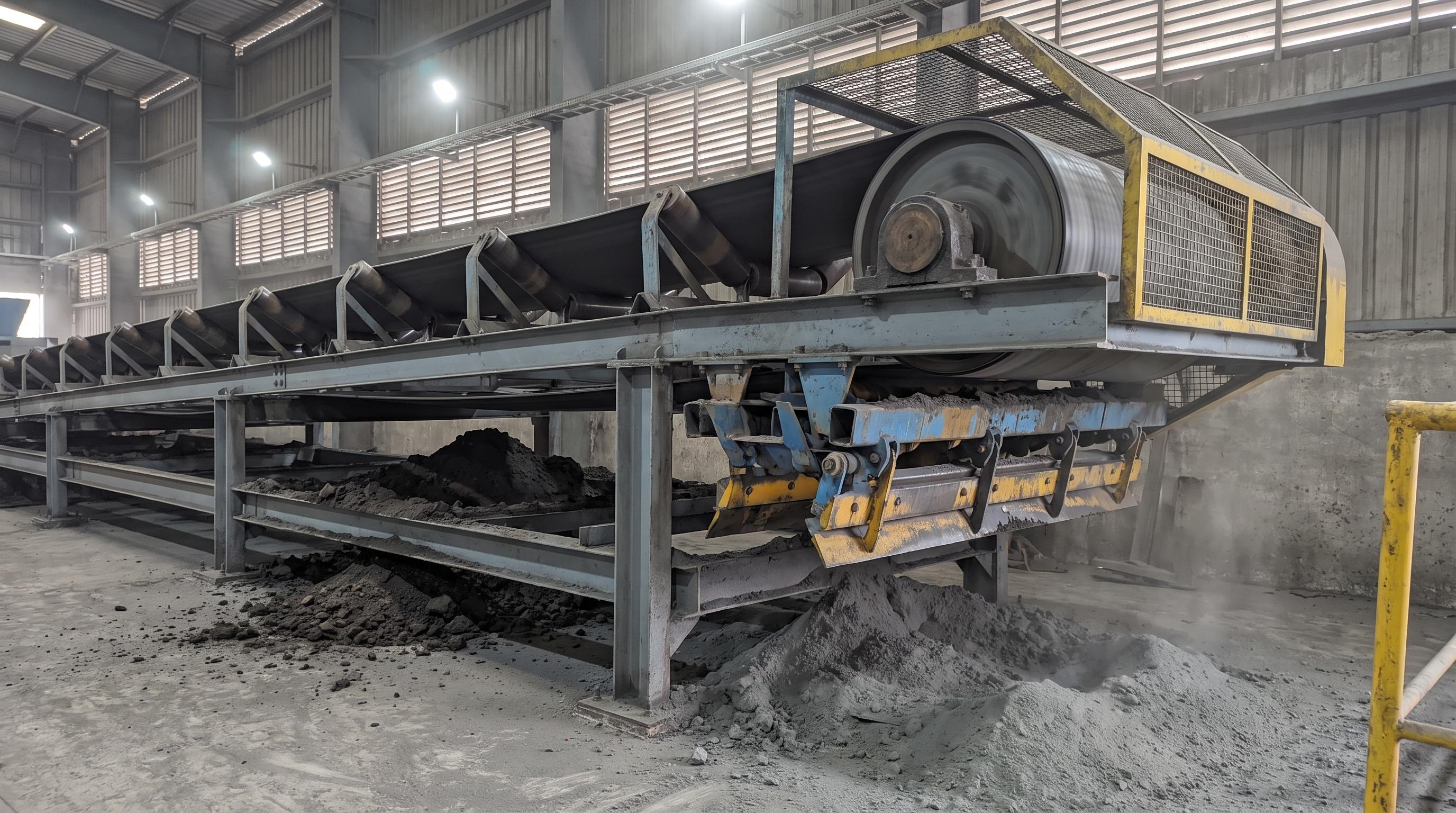
Conveyor carryback is material that stays on the belt after discharge and falls along the return side, causing spillage, roller build-up, mistracking, and extra cleanup. It is usually driven by ineffective belt cleaning, wet or sticky material, worn belt surfaces, and scraper setup issues. In most plants, the most reliable fix is a properly selected dual-stage belt cleaning system supported by good tracking, chute design, and return-side protection.
Let's face reality, if you run a bulk material plant, you're fighting a daily battle against dust and pile-ups under your conveyors. In my years auditing material handling lines across mining, cement, and steel plants, I’ve seen teams spend lakhs of rupees every month on manual cleanup and structural maintenance. The culprit? Conveyor Carryback.
The Carryback Failure Chain: From Spillage to Downtime
When carryback escapes the head pulley, it doesn't just sit on the floor. According to field data aligned with CEMA (Conveyor Equipment Manufacturers Association) Standards, it triggers a predictable, destructive domino effect across your mechanical components:
Phase 1: Initial Spillage: Fines escape cleaning.
Residual wet or abrasive material slips past an under-tensioned head scraper, sticking firmly to the belt's lower cover.
Phase 2: Component Scaling: Crust forms on rollers.
As the belt travels backward, loose fines are compressed onto the return Conveyor Rollers, building up hardened crust layers over time.
Phase 3: Geometry Distortion: Idler Crowning takes place.
Material accumulates heaviest in high-pressure center zones, creating a random, artificial "crown" that alters the roller's diameter.
Phase 4: Alignment Failure: Severe belt mistracking.
The uneven idler diameter shifts tracking forces. The belt drifts violently off-center, plowing into structural frames and ruining the edges of your Belt Conveyor System.
Phase 5: Catastrophic Stoppage: Unplanned downtime.
The combination of torn belt covers, structural friction, and giant spill piles trips safety switches, freezing your entire line's throughput.
If you're reviewing cleaner upgrades or planning a carryback-control improvement, this spec sheet gives your team a quick reference for application fit, installation considerations, and key solution details before you move ahead.
Root Causes: Why Material Sticks to Your Line
Through hundreds of field inspections, our reliability engineering teams have tracked down carryback to five main root causes.
1. Ineffective Cleaning Systems
The Physics: Scrapers rely on precise, calibrated line pressure. If tension springs relax or blades wear past their optimal scraping angle, a micro-layer of fines escapes.
Field Red Flag: Heavy, consistent material piles directly beneath the discharge area.
2. High-Moisture Material Dynamics
The Physics: Excess water creates capillary action between fine particles and the rubber belt, forming a strong vacuum bond that easily defies gravity.
Field Red Flag: Thick, paste-like material layer coating the entire belt width during rainy seasons.
3. Flawed Scraper Selection
The Physics: One size never fits all. Using a rigid tungsten carbide blade on mechanical fasteners, or choosing standard polyurethane for high-heat clinker lines, causes immediate mechanical failure.
Field Red Flag: Chipped cleaner blades, damaged mechanical splices, and high carryback bypassing the cleaner completely.
4. Degraded Belt Surfaces
The Physics: Scraper blades are rigid linear profiles designed for flat rubber. When a belt gets pitted, micro-cracked, or gouged, those imperfections act as tiny "pockets" that shield material from the blade.
Field Red Flag: "Striated" or streaky carryback lines along the return path matching your belt's wear scars.
5. Tracking and Tension Variances
The Physics: If a belt shifts laterally (side to side), it wanders outside the scraper's optimal cleaning profile. Similarly, a sagging belt creates air gaps, causing the cleaner blade to chatter and skip.
Field Red Flag: Cleaner blades wearing down completely unevenly on one side while the belt edges stay heavily coated.
The Operational Impact
To help your plant managers visualize the financial drain, here is how carryback directly impacts operational expenditure (OpEx). Industrial field data reveals that fugitive material loss can range from 3% in poorly operated systems to less than 0.1% in world-class operations, showing how quickly “small” carryback problems turn into measurable losses.
On the safety side, airborne respirable silica exposure must be controlled to 50 μg/m3 as an 8-hour time-weighted average under OSHA’s standard, which is why dust suppression and housekeeping cannot be treated as optional.
Impact Area | Real-World Operational Impact | Long-Term Business Consequence |
Housekeeping | Non-stop material build-up beneath conveyor galleries | Skyrocketing cleaning labor costs and wasted resource deployment |
Component Life | Sandpaper abrasive wear on return rolls, Conveyor Pulleys, and belt covers | Premature capital expenditure (CapEx) for replacement parts |
Reliability | Idler crowning leading to persistent belt misalignment | Unplanned line downtime and high risk of structural frame damage |
Safety & Risk | Slip and trip hazards alongside airborne respirable dust clouds | Severe workplace health hazards and strict regulatory compliance fines |
Is carryback and spillage reducing your plant's efficiency and increasing operating costs? Let our engineers identify the root cause and recommend practical solutions to optimize your material handling system.
Carryback Volume & Cost Calculation
Plant engineers can estimate the annual direct product loss resulting from uncleaned belts using the following mass flow balance:
Annual Material Loss (t/year) = (Cb × Wb × vb × 3,600 × Hop) / 1,000,000
Cb = measured carryback concentration (g/m²)
Wb = belt cleaning width (m)
vb = belt speed (m/s)
Hop = annual operating hours (h/year)
Example: For Cb= 40 g/m², Wb = 1.4 m, vb = 4.0 m/s, and Hop = 6,000 h/year, Annual Material Loss = (40 × 1.4 × 4.0 × 3,600 × 6,000) / 1,000,000 = 4,838.4 t/year.
Engineering Methods to Eliminate Carryback
Fixing carryback permanently requires moving away from reactive manual shoveling and focusing on structured, engineered solutions. Designing better access for cleaning and maintenance can reduce system downtime by up to 33%, which is why scraper access, chute inspection space, and return-side protection should be engineered into the line from the start.
1. Deploy a Dual-Stage Cleaning System
Never rely on a single scraper to clean high-capacity lines. For perspective, a residual material layer of just 0.1 mm on a 1,000 mm wide belt running at 2 m/s can accumulate up to 0.6 m³ of spilled material in just one hour. This explains why even a seemingly “minor” residue quickly turns into a massive housekeeping and maintenance burden.
Primary Polyurethane Scraper: Installed on the face of the head pulley below the discharge stream. This peels away the heavy bulk material (60-80%).
Secondary Carbide Scraper: Positioned right where the belt leaves the head pulley. Its rigid blades shave off the remaining fine, sticky film.
2. Optimize Blade Geometry
Positive Rake (Peeling Angle): Aggressive and highly efficient for sticky material, but requires precise mechanical tensioning to protect the belt cover.
Radial Rake (Scraping Angle): The safest option for older belts or lines with mechanical splices, relying on pure compression to shear material.
3. Correct Material Trajectory
Poor chute design allows discharged material to splash or blow back onto the underside of the belt. Optimizing your Transfer Chutes geometry ensures material moves cleanly away from the pulley face before it can re-adhere.
4. Install Internal Return Protection
Fugitive material falling onto the inside (clean side) of the return belt travels straight to the tail pulley. If trapped, it causes punctures. Installing a V-Plow or Diagonal Plow right before the tail pulley deflects this material off the line.
Choosing the Right Belt Cleaning Tool
System Type | Installation Zone | Best For | Core Advantage | Main Constraint |
Primary Polyurethane | Head pulley face | Coarse ores & large bulk | Flexible & splice-safe | Misses fine sticky films |
Secondary Carbide | Behind head pulley | Sticky fines & cement dust | High-precision micro-shaving | Risks poorly maintained splices |
V-Plow / Diagonal | Inside return belt | Internal strand spillage | Protects tail Conveyor Pulleys | Internal only; no outer cleaning |
Rotary Brush | Down-line return strand | Powders & chevron belts | Deep profile/pocket cleaning | Requires power; blinds if wet |
From the Field: A copper concentrator plant experienced continuous return-idler bearing failures on a 1,600 mm-wide overland filter-cake conveyor running at 3.8 m/s. Moist fine copper concentrate, with a carryback layer of 12 MTPH, adhered to the return rollers and formed hard 20 mm crusts within 48 hours.
The plant relied on a single, poorly tensioned primary scraper with worn polyurethane blades. Carryback passed over the primary cleaner, fell onto the first six return idlers, and caused severe belt wander. The off-centre belt then rubbed against the conveyor frame, damaging 120 m of belt edge.
Installed a dual belt-cleaning system: a heavy-duty modular primary scraper with dual elastomeric spring tensioners and a secondary tungsten-carbide cleaner with individual cushion mounts.
Replaced the first 10 smooth steel return idlers past the head pulley with rubber-disc return idlers to shed residual fines.
Installed a quick-opening, dust-tight inspection hatch on the chute to allow weekly visual checks of blade-wear indicators without stopping the line.
Carryback dropped by 96%, return-idler bearing life increased from weeks to more than 2 years, manual shovelling under the head structure was eliminated, and belt-edge damage ceased.
Final Takeaway
Conveyor carryback is not an unavoidable reality of material handling; it is the visible symptom of an unoptimized mechanical system. By selecting scraper materials based on material physics, keeping your lines tracked, and implementing multi-stage scraping, you protect your belt life, eliminate manual cleaning costs, and keep your throughput moving.
Frequently Asked Questions
It is the residual material that fails to drop off at the discharge chute, sticking to the rubber and shedding along the conveyor’s underside return path instead.
High moisture levels create capillary action and a strong vacuum-like bond between fine particles and the smooth belt surface, easily overcoming gravity.
In high-capacity or sticky environments, no. You need a multi-stage system: a primary polyurethane blade to move the bulk, followed by a secondary carbide scraper for the fine film.
Material builds up unevenly on return idlers, forming an artificial, raised "crown." This changing roller profile exerts uneven forces, forcing the belt off-center.
When dealing with extremely cohesive materials like wet clay or gypsum. The water spray breaks down the material's surface tension, allowing secondary scrapers to cleanly wipe it away.