
Complete Guide to Conveyor Idler Types and Selection for Cement, Steel & Power Plants

Vijay Baid
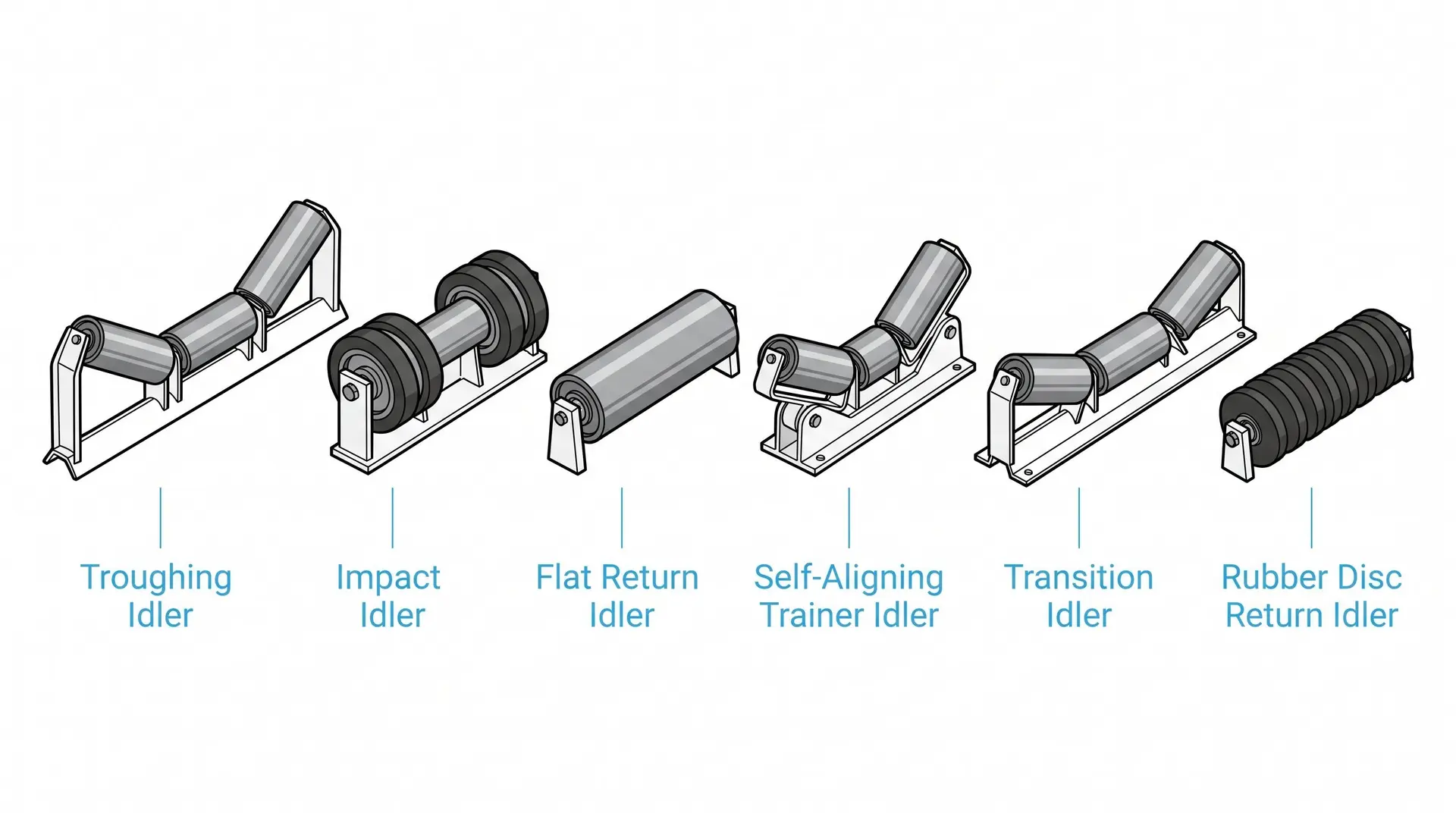
A troughing idler shapes the conveyor belt into a deep trough to securely maximize bulk carrying volume along the forward run. An impact idler features specialized resilient rubber rings positioned directly below material transfer zones to absorb crushing force and protect the belt shell. The critical mechanical mistake to avoid is installing standard steel carrying idlers under high-drop chutes; the unyielding impact will fracture your rollers, destroy the belt core, and create severe material spillage.
Let's look out for the real problem in heavy bulk handling: if you are running a high-capacity line in a cement, steel, or power plant, your conveyor system is only as reliable as the spinning steel beneath the belt. Plant teams frequently focus on massive drives, heavy belt ratings, or large storage silos, yet the primary cause of sudden tracking failures and premature belt wear usually traces back to an improperly specified conveyor idler frame.
Deploying a generic roller layout across highly demanding load zones is a direct route to structural misalignment, material spillage, and bearing failures. Let's skip the rigid catalog tables and examine the actual field requirements for selecting the ideal heavy-duty idler types for your plant's heavy processing lines.
The Critical Divide: Carrying, Shock Absorption, and Path Return
To establish a highly efficient conveyor framework, your engineering layout must map the specific structural needs across each independent segment of the conveyor line.
Carrying and Troughing Sets: Positioned along the top run of the system to hold the loaded rubber. They use a multi-roll configuration most commonly a 3-roll profile fixed at 35o or 45o angles to wrap the belt into a dynamic trough shape that contains the loose bulk material.
Impact and Transition Sets: Stationed directly inside material drop paths. They replace rigid steel pipes with high-density shock-absorbing profiles to handle continuous mechanical impact.
Return and Tracking Sets: Positioned on the lower, inverted run of the frame. They support the empty belt while utilizing self-aligning mechanics to correct lateral side-to-side drift before it causes frame rubbing.
Matching Your Idler Selection to the Industry
Let's break down the three primary plant layouts where selecting the right idler profile directly protects your operating uptime.
1. Cement Plants (Abrasive Dust & High-Heat Loops)
The Environments: Limestone primary crushing, clinker storage loops, and raw meal distribution lines.
Best Idler Choice: Deep 45o Troughing Idlers with triple-labyrinth grease seals and heavy-wall steel tubes.
Why It Matters: Clinker and limestone dust act like fine sandpapers. If abrasive dust works its way past the roller seals, the internal ball bearings lock up within weeks. When a roller freezes, the moving rubber creates an immediate frictional abrasive hotspot that shears the lower belt cover. For automated feed lines, ensuring your idlers hold a consistent trough profile prevents material overflow before it hits an isolation gate like a Flow Control Gate.
2. Steel Plants (Heavy Mass & Hot Sinter Duties)
The Environments: Iron ore blast furnace feeding, hot sinter return loops, and coke screening plants.
Best Idler Choice: Heavy-Duty Impact Idlers with thick vulcanized rubber rings, paired with reinforced steel brackets.
Why It Matters: Iron ore is incredibly dense and sharp. Dropping heavy lumps from primary storage chutes onto a moving belt exerts massive localized forces. Standard carrying idlers will crack under this stress. Using high-deflection impact idlers directly beneath the feed chute prevents structural fractures. If you are routing material between different process towers via a multi-port Diverter Valve, matching the impact rating at the drop point ensures the belt handles the redirected surge without shifting off-center.
3. Power Plants (High-Velocity Coal & Fly Ash Routing)
The Environments: High-speed coal handling lines, stacker-reclaimer loops, and fly ash disposal circuits.
Best Idler Choice: 35o Carrying Idlers paired with automated Self-Aligning / Training Idlers spaced at regular intervals.
Why It Matters: Coal systems run at high operational velocities, often exceeding
3.5 m/s to 5m/s. At these speeds, even a minor structural shift will cause the belt to drift off-track instantly. Self-aligning idlers feature a central pivoting base that reacts to belt tracking errors, steering the belt back onto the true centerline. If your fly ash system routes fine dust away from your Dampers exhaust stack down to a Screw Conveyor, stable belt tracking ensures dust collectors stay properly aligned without spilling material.
Need the key specs in one place before you finalize your purchase or retrofit plan? Download the conveyor idler spec sheet for a quick reference on installation zones, roll diameters, load classes, sealing options, and where each idler type fits across cement, steel, and power plant duty.
Conveyor Idler Comparison
Idler Type | Primary Installation Zone | Best For | Core Advantage | Main Performance Limit |
Standard Troughing | Main carrying strand (1.2m to 1.5m spacing) | Bulk conveying (ore, coal, limestone) | Maximizes cross-sectional load volume | Rigid steel shells cannot absorb heavy impacts |
Impact Roller | Direct material transfer drop points | High-drop chute paths | Absorbs heavy shock to protect belt cover | Polyurethane or rubber rings degrade if exposed to high heat |
Flat Return | Clean side return strand (3m spacing) | Supporting the inverted belt profile | Low structural friction along the path | Susceptible to scale build-up from carryback |
Self-Aligning / Trainer | Strategic points along carrying & return runs | Real-time tracking correction | Automatically steers the belt to center | Requires active pivoting mechanism; can bind if dirty |
Selection Checklist: The Structural Spec Criteria
Before updating your plant procurement specs, verify that your engineering team has checked these key design factors. For conveyor operating and start-up safety requirements, refer to OSHA conveyor safety requirements.
Load Rating and Idler Specification: Match your line duty, belt width, load, and spacing to the correct idler class and dimensional standard before finalizing procurement. For Indian specification references, see the BIS idler and idler sets specification and the BIS steel tubes for idlers specification.
Are frequent roller failures, severe belt mistracking, or excessive spillage at your transfer points increasing your plant's manual maintenance costs? Stop dealing with conveyor downtime.
From the Field: We were called to a thermal power station where their main coal reclaim conveyor was tearing through a new belt cover every four months. The team had recently updated their incoming chutes to handle larger coal chunks but left the original steel carrying idlers directly under the drop point.
The constant impact of the coal shattered the bearings inside the middle steel rollers, locking them in place. The moving belt was dragged across the frozen steel faces, wearing the roller shells down into razor-sharp edges that sliced long grooves into the lower belt cover.
We resolved the tracking and component wear issue by tearing out the first four steel frames and installing reinforced Impact Idlers with high-resiliency rubber discs, alongside an automated tracking trainer downstream. The belt wear issues stopped immediately, and the system has operated smoothly for over eighteen months.
Final Takeaway
Optimizing your dry bulk conveying loop relies on matching the load profile and physical environment of your line to the mechanical design of your idlers. Use heavy-walled troughing idlers to carry your main product volume reliably, install high-deflection impact idlers to protect your components under feed chutes, and use self-aligning tracking frames to prevent edge damage.
When your idler configurations work in step with your down-line bulk dosing and distribution machinery such as automated Belt Conveyors discharging into specialized Screw Conveyors you protect your plant from unplanned shutdowns and maximize long-term material throughput.
Frequently Asked Questions (FAQ)
When fine, moist particles escape the primary head scraper, they stick to the lower belt cover. As the belt runs backward across the return idlers, the rollers compress this residual material into a hard crust. Over time, this buildup deforms the roller's diameter, causing severe belt mistracking.
For typical bulk materials like coal or limestone, standard carrying idlers are spaced between 1.2 meters and 1.5 meters apart. Spacing them too far causes the belt to sag between frames, increasing dynamic power consumption and causing material spillage at the edges.
Choose rubber disc return idlers when handling sticky or wet materials that tend to carry back along the return strand. The flexible rubber rings flex under pressure, breaking up the scaling crust and keeping the face of the roller clean.
Transition idlers are placed directly at the head and tail ends of the conveyor, where the belt changes shape from a deep 35o or 45o trough down to a flat pulley profile. They use adjustable intermediate angles (like 10o or 20o) to ease the rubber through the change without over-stretching the edges