
Engineering Sustainability: The Role of Conveyors in a Greener Future

Vijay Baid
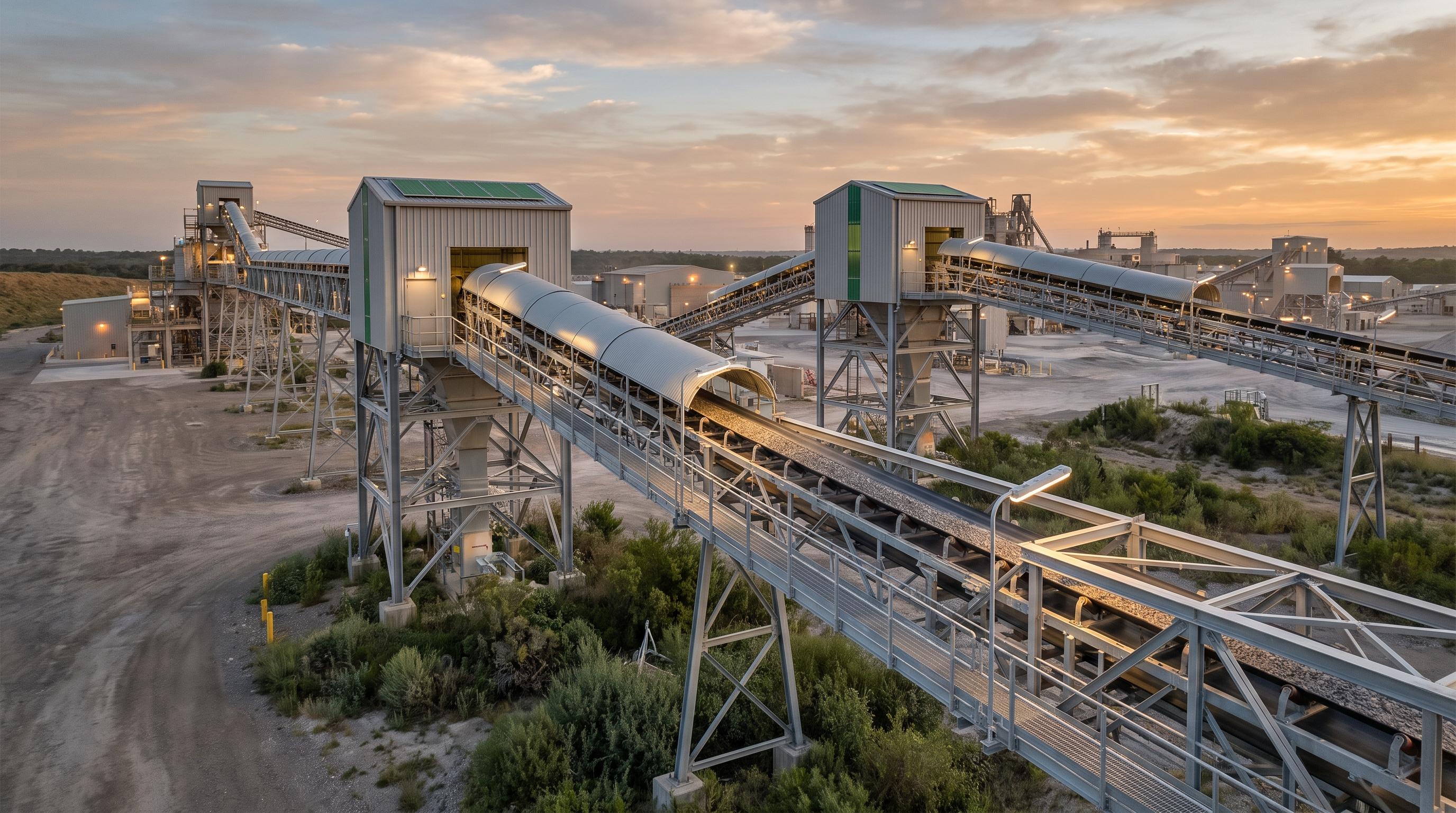
Conveyors support greener bulk material handling when they replace diesel haulage, reduce rolling resistance, use efficient drives, and control dust at transfer points. The biggest sustainability gains come from system design, not from one premium component. Belt selection, idler quality, drive control, chute sealing, and operating profile must work together to cut energy use, lower emissions, reduce spillage, and improve uptime.
Introduction: The Hidden Energy Drain in Heavy Industry
In mining, cement, steel, and power plants, moving bulk material is a major energy load. The transport step may look simple, but it affects fuel use, electrical demand, dust generation, maintenance hours, and total cost per ton moved.
For many plants, the biggest sustainability gap is not in the kiln, crusher, or mill. It is in how raw material moves between them. Diesel haul trucks, poorly selected belts, worn pulley lagging, misapplied idlers, unresolved tracking drift, and open transfer points can waste large amounts of energy every day.
That is why conveyors matter in decarbonization planning. A well-designed conveyor can move more material with less energy per ton-km than truck haulage. It can also cut direct emissions, reduce noise, and control fugitive dust more effectively. That matters because fine-particle pollution remains a serious operating and environmental issue, as outlined in EPA guidance on particulate matter. But these gains only hold when the system is designed well. If sealing, controls, or component selection are weak, the environmental benefit drops quickly.
Technical Comparison: Truck Haulage vs. Overland Belt Conveyors
Performance Metric | Diesel Heavy Haul Trucks | Standard Belt Conveyors | Optimized Green Overland Conveyor |
Primary energy source | Diesel fuel with direct Scope 1 emissions | Grid electricity with indirect Scope 2 emissions | Electrified system with regenerative capability and renewable-power integration |
Energy use per ton-km | About 0.25 to 0.40 kWh per ton-km equivalent | About 0.08 to 0.15 kWh per ton-km | About 0.03 to 0.07 kWh per ton-km |
Relative carbon footprint | Baseline: 100% | Roughly 30% to 45% lower than truck haulage | Roughly 65% to 85% lower than truck haulage |
Dust and noise | High due to exhaust, road dust, tire wear, and engine noise | Moderate if transfer points are open or poorly sealed | Low when the route is enclosed and transfer points are properly sealed |
Operating cost | High because fuel, tires, engines, and brakes are continuous cost drivers | Moderate with routine belt, bearing, and splice maintenance | Lower when drive control, belt selection, and condition monitoring are well engineered |
Terrain and footprint | Needs wide haul roads, drainage, and regular road maintenance | Needs a fixed structural route | Can cross long distances and handle steep profiles, often around 18° to 22° depending on material and belt design |
The 4 Pillars of Sustainable Conveyor Engineering
A sustainable conveyor is built around four engineering levers: electrification, rolling-resistance reduction, regenerative control, and containment of dust and spillage. If one of these is weak, the whole system loses efficiency.
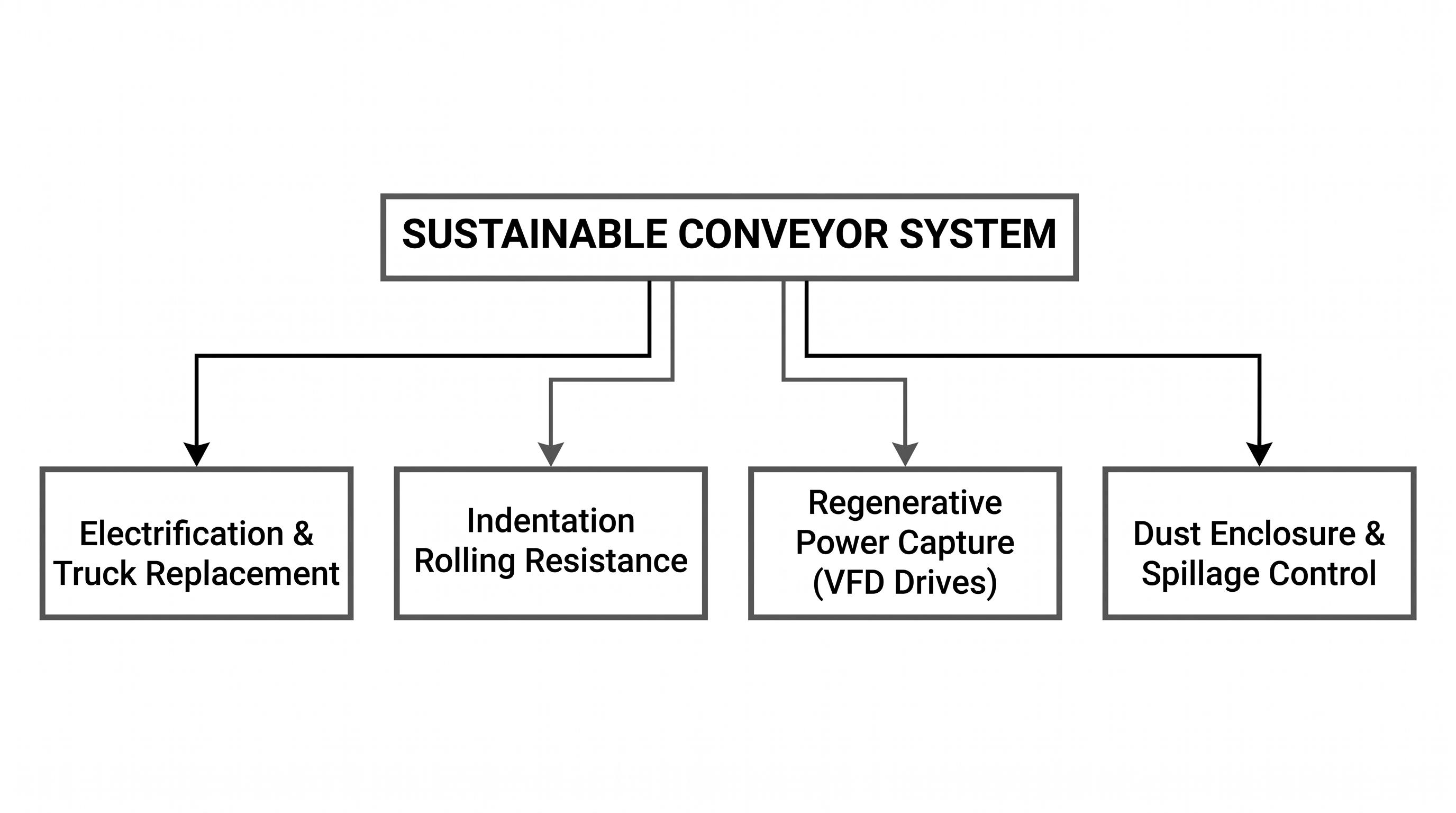
1. Electrification and diesel haul fleet replacement
Replacing diesel haul trucks with a continuous conveyor is often the fastest way to cut direct transport emissions in a bulk-material operation. Electric motors convert a much larger share of input energy into useful motion than diesel engines, and they do it with far less day-to-day mechanical waste.
Why it works: Heavy truck engines often operate at low overall efficiency once idle time, variable loading, road resistance, and stop-start duty are considered. Conveyor drives, by contrast, can run above 90% efficiency under stable operating conditions.
Why it matters in practice: A conveyor also removes fuel logistics, lowers road-maintenance demand, reduces tire waste, and makes it easier to connect transport energy to solar, wind, or a cleaner grid mix.
What goes wrong if it is poorly planned: Plants sometimes replace trucks with a conveyor but keep weak transfer-point design, oversized motors, or poor control logic. That still reduces diesel use, but it leaves avoidable electrical losses in the system.
2. Reducing indentation rolling resistance
On long overland conveyors, a lot of drive power is used just to overcome indentation rolling resistance. Put simply, the belt deforms each time it passes over an idler. The rubber does not return all that energy. Part of it is lost as heat. That is why standards such as ISO 5048 and DIN 22101 treat conveyor resistance as a key part of power calculation.
This is why belt compound matters. A low rolling resistance bottom cover reduces hysteresis losses and lowers continuous drive demand. The gain becomes more important as conveyor length, tonnage, and running hours increase.
Typical effect: On long conveyors, indentation rolling resistance can account for roughly 60% to 70% of the total drive demand.
Practical saving range: A good low rolling resistance belt can reduce indentation-related losses by about 20% to 40%, depending on belt construction, ambient temperature, idler spacing, and duty.
If ignored: A plant may install high-efficiency motors and still miss the real savings because the belt itself keeps wasting power across every idler set.
3. Regenerative energy capture on declining conveyors
When material moves downhill, gravity can drive the belt faster than the motor would normally pull it. In that condition, the conveyor can become a controlled generator instead of a pure power consumer.
With a regenerative variable frequency drive, the motor applies holdback torque to keep belt speed stable while sending usable electrical power back into the plant supply. That energy can offset power demand elsewhere in the process line.
Engineering value: Regeneration improves energy efficiency and also gives much better speed control than relying on braking alone.
Example scale: A declining conveyor carrying 2,500 TPH down a 100 m drop can recover more than 500 kW under the right conditions.
If done badly: Weak control tuning, poor belt tension management, or underdesigned braking strategy can create unstable belt behavior, slip, or unsafe stopping performance.
4. Spillage prevention and air-quality control
Sustainability is not only about power. It is also about material loss, housekeeping burden, air quality, and worker exposure. Open transfer points and poor skirt sealing allow fines to escape, raise PM2.5 and PM10 exposure, and create constant cleanup work. That is why dust control should be treated as a design responsibility, not only a housekeeping task, especially when plants are trying to reduce the kinds of particulate risks described in EPA particulate-matter guidance.
Better containment reduces waste and protects reliability. When product stays on the belt, plants avoid carryback, return-side build-up, premature idler failure, and the wider conveyor downtime chain that follows around structures and walkways.
What works: Enclosed conveyors, properly designed chutes, impact support, primary and secondary belt cleaners, and effective skirt sealing.
Why it matters: These changes reduce visible dust, protect surrounding equipment, and help plants meet stricter environmental expectations.
What happens if ignored: Spillage becomes a repeating maintenance issue, dust reaches bearings and pulleys, and the plant pays for the same ton more than once through loss, cleanup, and wear.
Design checks that matter before you call a conveyor sustainable
A conveyor does not become sustainable just because it runs on electricity. The design still has to match the duty. Capacity, component choice, and operating conditions must be checked against proven references such as CEMA guidance instead of loose vendor claims. On the mechanical side, conveyor idler selection deserves as much attention as the drive and the belt. These are the checks that matter most:
Material characteristics: Lump size, fines content, moisture, abrasiveness, and angle of repose directly affect belt type, chute design, and sealing strategy.
Route profile: Horizontal curves, lift, decline, and total length determine whether regeneration is possible and how much belt tension the system must manage.
Duty cycle: A conveyor running 24/7 gains far more from rolling-resistance reduction and good control logic than a lightly used standby line.
Idler quality: Poor sealing, shell runout, or frame misalignment can cancel out the gains from a premium belt or efficient motor.
Drive philosophy: Fixed-speed drives are often simple, but variable speed control is usually better for real energy management.
Transfer-point engineering: If loading is unstable, dust containment and belt life both suffer. A sustainable system must control material flow, not just move it.
Common design mistakes that waste industrial energy
Oversizing the drive without control logic: Plants sometimes size motors for the worst short-duration peak and then run that full installed capacity all the time. A properly tuned variable speed system usually performs better.
Ignoring idler alignment and concentricity: Misaligned frames and poor-quality rollers increase drag, raise belt wear, and waste energy continuously.
Using the wrong lagging on the drive pulley: Slip wastes energy as heat. It also damages the belt bottom cover and reduces traction reliability.
Treating dust as a housekeeping issue only: Dust is also a reliability and energy issue because it shortens bearing life, increases clean-up load, and often points to poor material control.
Choosing the cheapest belt instead of the right belt: On a long conveyor, the wrong belt compound can lock the plant into higher energy use for years.
Field experience insight: decarbonizing a cement quarry
From the field: A major cement producer in Southern Europe moved about 1,800 TPH of limestone from a quarry above the plant to the kiln line over a 6.2 km route. The original setup used 12 diesel haul trucks. Fuel use was high. Road upkeep was constant. Nearby communities also complained about dust and noise.
The plant replaced the truck route with a curved overland conveyor. It used a low rolling resistance belt, regenerative drives on the declining sections, and precision idlers selected for stable, low-noise running. The transfer points were also redesigned. That reduced spillage and kept fines inside the chute path.
The results were practical, not theoretical:
Direct carbon reduction: Scope 1 emissions from haulage fell by about 88%, cutting more than 3,600 tons of greenhouse-gas emissions per year.
Energy recovery: The declining sections returned roughly 320 kW of usable power to the plant during steady operation.
Noise reduction: Boundary noise dropped from about 78 dBA to below 52 dBA.
Operating impact: The plant reduced haul-road maintenance, cut dust complaints, and gained more stable material flow to the downstream process.
Final Takeaway
A greener material-handling system does not come from one efficient motor, one premium belt, or one enclosed chute. It comes from engineering the full conveyor path to waste less energy and lose less material at every stage.
For plant teams, the practical goal is clear: move each ton with less fuel, less electrical loss, less spillage, and less unplanned maintenance. That means starting with the biggest losses first: diesel haulage, rolling resistance, belt slip, poor tracking, and open transfer zones. When those problems are solved in the right order, conveyor sustainability improves both environmental performance and daily operating economics.
Frequently Asked Questions
In practice, low rolling resistance belting can reduce indentation rolling resistance by about 20% to 40%, depending on conveyor length, temperature, idler spacing, belt construction, and loading pattern. On long overland conveyors, that often translates into a total drive-energy reduction of roughly 10% to 25%.
When the loaded belt tends to run downhill faster than the drive would normally pull it, the motor shifts into generating mode. A regenerative variable frequency drive applies counter-torque to control speed and sends electrical power back into the plant supply.
They can be, especially where containment matters more than absolute lowest drive demand. Pipe conveyors usually need slightly more power to form and hold the closed belt shape, but they are often much better at preventing spillage, limiting dust, and protecting the surrounding environment.
They reduce direct fuel burning, improve dust containment, and make material movement more predictable. Enclosed transfer points, better sealing, and lower reliance on diesel haulage all help plants align with stricter emissions and workplace-exposure expectations.
Engineers commonly refer to CEMA guidance, DIN 22101, and ISO 5048 when evaluating conveyor resistance, power demand, and design assumptions. The exact standard set depends on region, customer specification, and project basis of design.