
Material Handling
Offset Rotary Valve: Working Principle, Use Cases, and When to Choose It

Vijay Baid
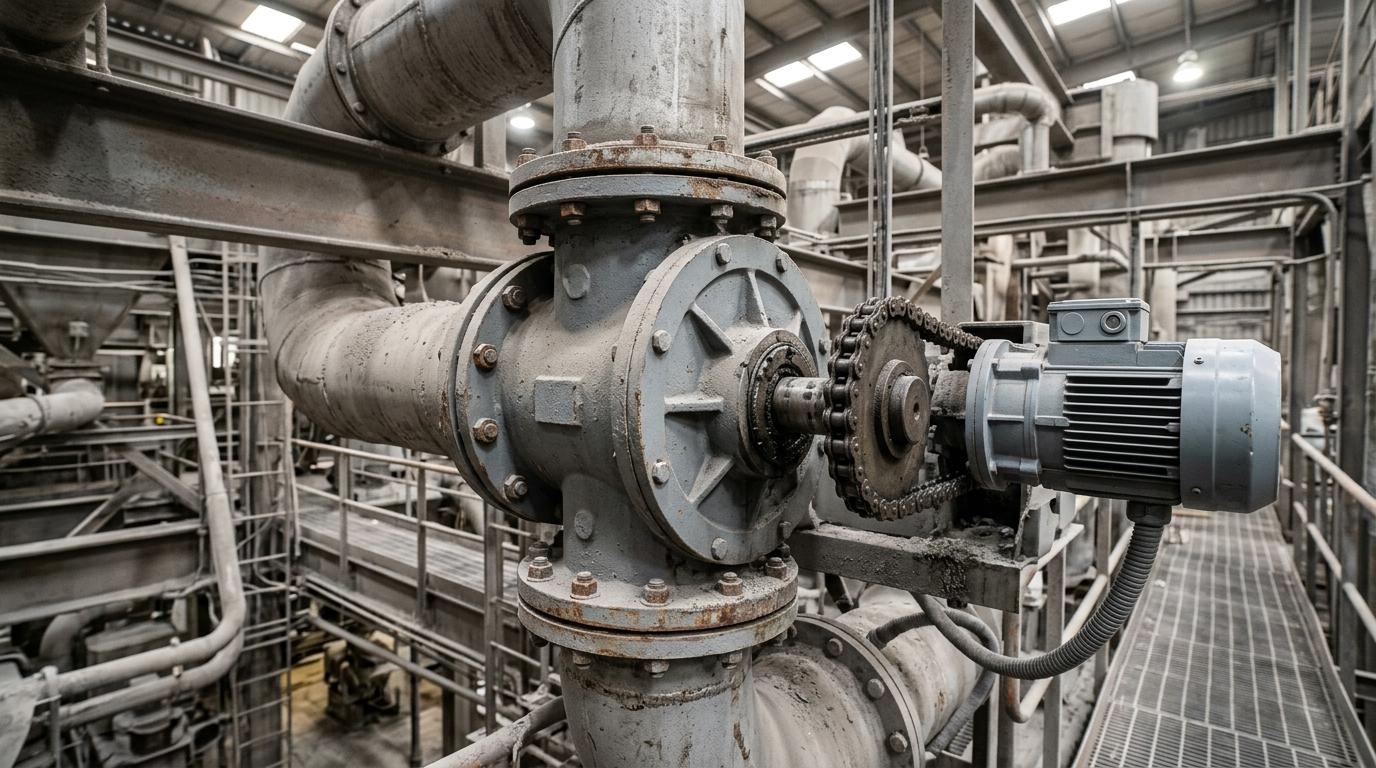
An offset rotary valve is worth choosing when a standard rotary airlock is damaging friable material, creating extra fines, or adding dust at a sensitive transfer point. Its offset inlet geometry reduces pinch shear as pockets fill, which helps protect product quality. If the material is not degradation-sensitive, a standard rotary airlock is usually the lower-cost choice.
An offset rotary valve is designed to handle bulk material more gently than a standard rotary airlock. When fragile material breaks down at the valve, it can lead to more fines, dust, cleanup, and product loss. This is where an offset rotary valve can be useful.
A standard rotary airlock is still a common choice for general-duty material handling. It is simple and cost-effective. But when the material is fragile or sensitive to breakage, the valve design becomes more important.
This guide explains how an offset rotary valve works, where it is used, and what to check before choosing one.
What Is an Offset Rotary Valve?
An offset rotary valve is a type of rotary airlock used to control the flow of bulk materials. It is often installed below hoppers, silos, and cyclones.
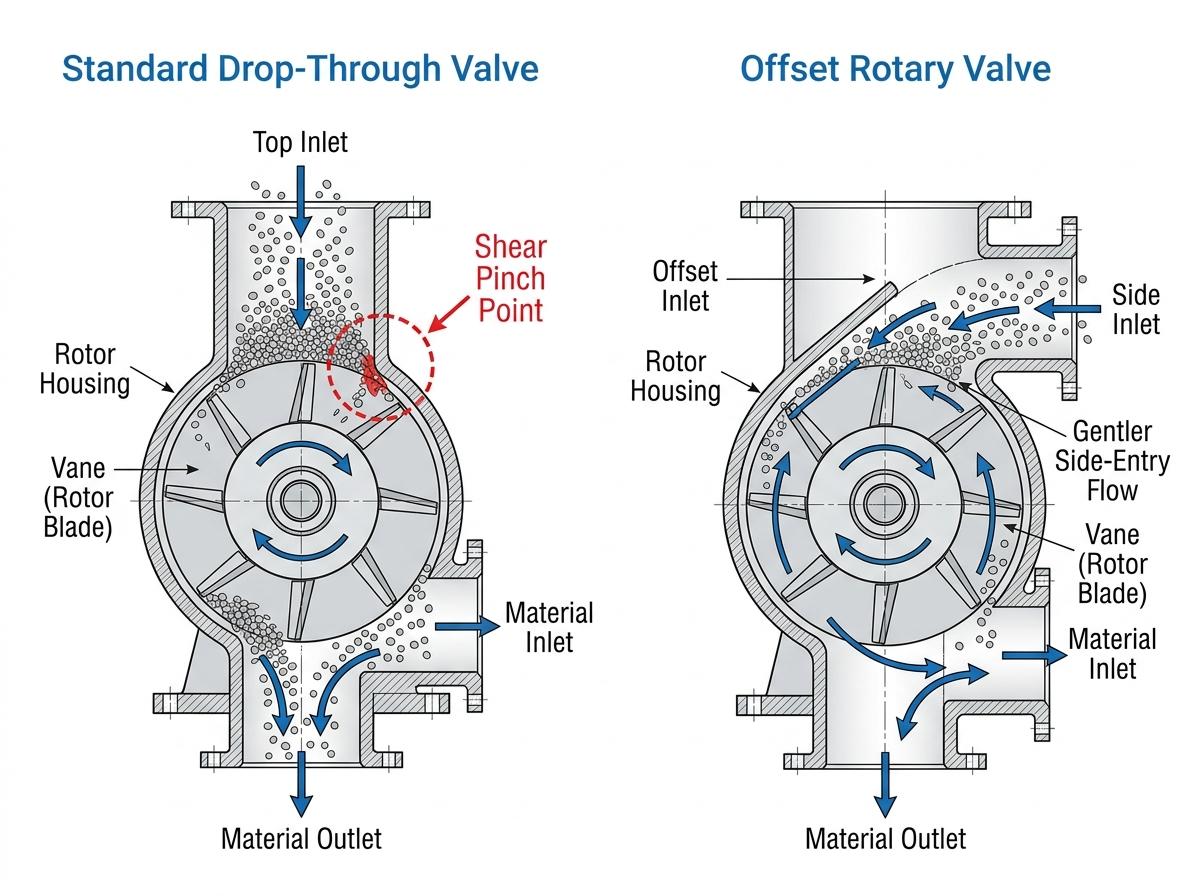
The key difference is the offset material entry. In a standard rotary airlock, material enters the rotor more directly. In an offset design, the entry point is shifted to reduce the chance of material being pinched between the rotor and housing.
This can help reduce crushing and shearing, making the valve useful for materials where product quality and particle size matter.
How Does an Offset Rotary Valve Work?
The working principle matters because most product damage happens at the point where material enters the rotor pocket and the pocket begins to close. An offset rotary valve is designed to make that transition gentler, which is why it is chosen for sensitive material rather than routine discharge duty.
Material enters the valve from above and fills the pockets between the rotor blades. As the rotor turns, it carries the material toward the outlet.
The offset design changes the filling path of the material before the blade tip passes the housing. Instead of forcing product into a tighter closing zone, it gives the material a more forgiving entry path, which can reduce pinch shear and lower the risk of particle breakdown.
Here is the basic process:
Material enters the valve from the inlet.
Material fills the rotor pocket through the offset entry area.
The rotor turns and carries the material toward the outlet.
Material leaves the valve through the bottom opening.
The valve continues to control material flow while helping maintain the pressure difference in the system.
The main benefit is that the material is less likely to get trapped between the rotor blade and the housing at the most aggressive point of closure. In practice, that can mean fewer fines, less dust at the transfer point, and more stable downstream handling when the product is sensitive to breakage.
This can help reduce pinching, crushing, and shearing.
Why Is the Offset Design Important?
Fragile materials can break when they are caught between moving and fixed parts of a valve.
This can create:
More fine particles
More dust
Product damage
Changes in product quality
More cleaning work
Problems in downstream equipment
An offset rotary valve changes the way material enters the rotor. This helps reduce the direct pinch point found in some standard rotary airlock designs.
In simple terms, the valve is designed to move sensitive material more gently.
Where Are Offset Rotary Valves Used?
Offset rotary valves are most useful in processes where material damage creates a measurable operating cost. The strongest applications are the ones where breakage leads to fines generation, dust, product-quality variation, or extra load on downstream equipment such as packing, conveying, or screening systems.
1. Cement and Mineral Handling
Cement, clinker, and other mineral materials can create fines when they are handled roughly. An offset valve can help reduce unnecessary material damage at certain transfer points. For abrasive materials, the valve must also be selected with the right wear protection.
In cement and mineral handling, this usually becomes relevant at transfer points where the material has already reached a more valuable or more quality-sensitive stage. Typical review points include discharge below hoppers, intermediate transfer points before packing, and areas where operators are already seeing excess fines, visible dust, or unstable feeding behavior.
2. Food Processing
Some food products need to keep their shape and size.
Examples include:
Breakfast cereals
Coffee beans
Nuts
Pet food
Freeze-dried products
Gentle handling can help reduce cracking and crushing.
3. Plastics and Polymers
Plastic pellets can be damaged when they are exposed to too much friction or shear. This can create small string-like pieces, sometimes called angel hair. An offset design can help reduce this type of material damage.
4. Chemical and Pharmaceutical Materials
Some chemical and pharmaceutical products are made of fragile crystals, granules, or agglomerates. Breaking these materials can change their particle size and create extra dust. An offset rotary valve can help protect particle size during transfer.
5. Agriculture and Grain Handling
Seeds, grains, and other agricultural products can be damaged during handling. An offset valve can help reduce cracking and breakage when gentle material handling is important.
Offset Rotary Valve vs. Standard Rotary Airlock
Both valve types are used to control the flow of bulk materials. The main difference is how they handle the material.
Feature | Standard Rotary Airlock | Offset Rotary Valve |
|---|---|---|
Best for | General bulk material handling | Fragile or sensitive materials |
Material entry | More direct | Offset entry |
Product handling | Normal | Gentler |
Main benefit | Simple and reliable operation | Helps reduce material damage |
Fines risk | Can be higher with fragile materials | Can help reduce fines |
Cost | Usually lower | May cost more |
Best use | Routine applications | Applications where product damage matters |
A standard rotary airlock is still a good choice for many applications.
If the material is not fragile and there is no problem with fines or product damage, an offset valve may not provide enough extra value to justify the higher cost. In those cases, a standard slide gate or knife gate valve arrangement may still be the better fit elsewhere in the line, depending on the duty.
When Should You Choose an Offset Rotary Valve?
An offset rotary valve may be worth considering when your process has one or more of these problems:
The Material Breaks Easily
If the material is fragile, it may break when it passes through a standard valve.
You See Too Many Fines
If the valve is creating more small particles than expected, the valve design may need to be reviewed.
Product Quality Is Important
Some products need to maintain their original size and shape. Damage during handling can affect the final product.
The Valve Gets Jammed
Large or rigid particles can sometimes get caught between the rotor and housing.
An offset design can help reduce this type of problem in suitable applications.
Dust Is a Concern
Broken particles can create extra dust.
If dust is linked to material breakage at the valve, a gentler valve design may help. For wider dust-risk controls, plant teams should also review public guidance from OSHA on combustible dust and the UK HSE guide on safe handling of combustible dusts when dusty powders are part of the duty.
What Should You Check Before Selecting One?
Choosing an offset rotary valve should start with the actual process problem, not with the assumption that a more specialized design is automatically better. The goal is to confirm whether the plant is truly losing value through material degradation at the valve or whether the issue is actually related to wear, venting, chute design, or line conditions. Where dust or explosion risk is part of the evaluation, it is worth cross-checking the process against authoritative public guidance such as OSHA combustible dust guidance.
Ask these questions:
Is the material fragile?
Is the material creating too many fines?
Is product damage happening at the valve?
What is the required material flow rate?
Is the material abrasive?
What are the pressure and temperature conditions?
Is the valve showing signs of wear?
Could the problem be caused by the chute, venting, or downstream equipment?
These checks can help you avoid choosing a more complex valve when a standard rotary airlock can do the job.
A useful rule is this: if the plant cannot clearly connect fines, dust, jamming, or product damage to the valve itself, start with the simpler rotary airlock and review sizing, clearances, and system layout first. If the evidence points to product damage at the valve, offset geometry becomes much easier to justify.
Common Mistakes When Choosing an Offset Rotary Valve
Choosing It for Every Application
An offset rotary valve is not automatically better for every process. It is better only when gentler pocket filling solves a real plant problem, such as product degradation, high fines generation, or dust linked to breakage at the valve. Without that evidence, the plant may end up paying more for a feature that does not materially improve performance.
If the material is easy to handle and does not break, a standard rotary airlock may be enough.
Ignoring Wear
Abrasive materials can wear the valve over time.
The correct materials and wear protection are important for longer service life.
Blaming the Valve for Every Problem
Poor chute design, poor venting, or restrictions further down the line can also cause flow problems.
The full system should be checked before changing the valve.
Using General Data Instead of Actual Plant Conditions
Valve selection should be based on the real material and operating conditions.
Things such as material type, bulk density, flow rate, pressure, temperature, and abrasiveness should be considered.
Final Takeaway
An offset rotary valve is designed for applications where gentle material handling affects operating results, not just equipment preference. When the wrong valve geometry leads to fines, dust, quality drift, or unnecessary product loss, the offset design can become a practical way to protect both process stability and material value.
It can be useful when fragile materials are being crushed, sheared, or turned into fines during transfer.
A standard rotary airlock is still suitable for many general-duty applications. The right choice depends on the material, operating conditions, and the actual problem in the plant.
The best approach is simple:
Understand the material. Find the real problem. Then choose the valve design that matches the job.
If you are reviewing a live application and need to confirm whether offset geometry is justified, a quick engineering review can help you avoid overspecifying the valve or missing the real cause of fines, dust, or product damage.
Frequently asked questions
An offset rotary valve is used in applications where the product can degrade in a standard rotary airlock. It is chosen to reduce fines generation, protect friable material, and improve handling at dust-sensitive transfer points.
It works by positioning the rotor off the housing centerline so material enters the pocket through a gentler inlet zone. That reduces the pinching and shearing effect that can occur as the pocket closes in a standard design.
You should choose one when the plant can show that product breakage at the valve is causing measurable loss through fines, dust, or quality variation. If there is no evidence of degradation, a standard rotary airlock is usually enough.
No. Cement is a common use case, but any dry bulk process with fragile or quality-sensitive material can be a candidate. The real question is whether gentler handling creates process value.