
Self-Aligning Idlers: How They Work, When You Need Them, and How to Specify Them

Vijay Baid
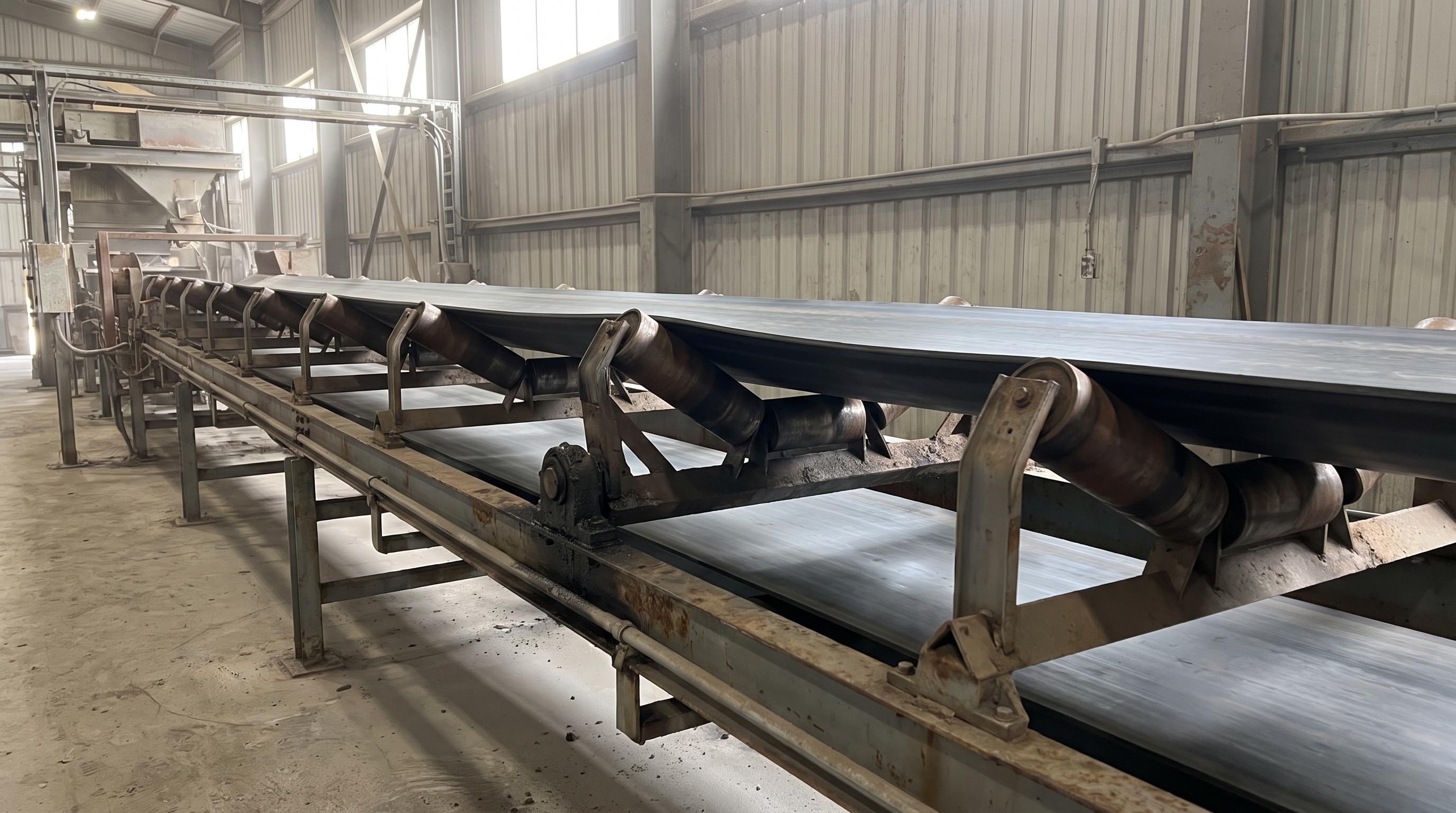
A self-aligning idler pivots about an off-centre point. When the belt touches a guide roller, friction creates a steering torque that turns the idler and walks the belt back to centre. Fit them about every 10th station on the carry side and every 6th on the return, keep them 15 to 20 metres clear of the pulleys, and correct pulley alignment first. They compensate for drift, they do not replace good alignment.
A self-aligning idler corrects belt mistracking on its own. When the belt drifts off centre, the idler pivots, steers the belt back, and returns to square, with no operator and no external power.
That matters because mistracking is one of the most persistent problems in bulk material handling. A belt that runs off centre spills material, wears its edges, damages structure, and in the worst case derails. Manual training fixes it for a shift, then it drifts again.
Self-aligning idlers fix the cause instead of the symptom. This guide covers how they work, why belts drift, when you actually need them, how far apart to install them, and how to specify one for your conveyor.
How does a self-aligning idler work?
It steers the belt using a pivot and friction, not a motor.
A standard idler bolts rigidly to the frame and stays square to the belt. A self-aligning idler sits on a vertical pivot instead, and the pivot point is set off centre, usually 50 to 100 mm from the idler axis. Small guide rollers stand on vertical posts at each end of the frame, just outside the belt edges.
The correction happens in a simple loop:
When the belt runs centred, the idler stays square and nothing moves.
When the belt drifts, its edge touches a guide roller. The moving belt against the stationary roller creates a friction force.
Because the pivot is off centre, that force becomes a torque, and the idler frame turns.
The turned idler now sits at an angle to belt travel, which steers the belt back toward centre.
As the belt re-centres, it leaves the guide roller, and the idler returns to square.
The whole thing is a self-correcting feedback loop. No power, no controls, no operator. The design work is in the geometry: enough pivot offset to correct quickly, but not so much that the belt overcorrects and hunts side to side.
Why do conveyor belts mistrack?
Because small, steady sideways forces build up along a long conveyor and push the belt off its centre line. A few causes account for most of it:
Pulley misalignment. A pulley out of square by as little as 0.5 degrees steers the belt continuously. IS 11592 sets a pulley alignment tolerance of about 2 mm across the face, and field conditions often drift past that within months.
Uneven loading. Material dropped to one side of the belt at a transfer point loads it unevenly and pulls it off line. This is common on kiln-feed and clinker conveyors.
Belt camber. Every belt has some built-in bow from splicing and carcass variation. CEMA notes that no belt tracks perfectly straight on its own.
Wind. On long outdoor yard conveyors, sustained crosswind is enough to push the belt sideways.
Idler frames out of square. One frame set slightly askew steers the belt locally, and the errors add up across many stations.
The pattern is the same across cement, steel, and power plants: the longer and more exposed the conveyor, the more these small forces accumulate, and the harder the belt is to keep centred by hand.
What does mistracking cost you?
More than a bit of spilled material. Uncorrected drift shows up across maintenance, safety, and production:
Spillage. A belt edge riding the structure pushes material over the skirting, which is lost product and a housekeeping load.
Belt edge wear. Continuous contact between the belt edge and steelwork wears the edge and shortens belt life.
Structural and bearing damage. Side forces bend idler frames and side-load bearings, cutting their service life.
Downtime. A badly tracked belt eventually stops the conveyor, and a derailment is a safety incident, not just a delay.
This is the case for fixing the cause. The idlers we build in pivot-type and tilt-type designs are meant to hold the belt centred continuously, so these costs never start to accumulate. On long, dusty plant conveyors, that continuous correction is work no manual training routine can keep up with.
Types of self-aligning idlers
There are three common designs, and the choice follows belt speed, duty, and which side of the belt you are correcting.
Type | How it corrects | Best for |
|---|---|---|
Pivot-type | Central vertical pivot; guide rollers at the belt edges turn the whole frame | General carrying-side duty, 1.5 to 4.0 m/s, belts 800 to 1400 mm |
Friction-activated tilt | Belt edge contact tilts one end of the frame, crowning it to steer the belt | Lighter conveyors and return runs, lower cost |
Controlled-tilt | Spring-loaded or damped tilt for a smooth, stable response | Long overland belts above 4.0 m/s where fast corrections would cause hunting |
The pivot-type is the workhorse for troughed carrying idlers, usually carrying three rollers at a 35 or 45 degree troughing angle. The friction-activated tilt is the simpler, cheaper answer on return strands, where belt sag gives enough contact pressure to work. The controlled-tilt is the specialist, used where speed and long horizontal curves make a raw, fast correction risky.
When do you need self-aligning idlers?
Not every conveyor needs them. They earn their place where drift is likely or expensive to ignore:
Long conveyors. Beyond about 500 metres, alignment tolerances add up and mistracking becomes likely.
Horizontal curves. Any curve pushes the belt toward its outside. Self-aligning idlers through the curve hold it on line.
Wind-exposed yards. Outdoor conveyors in steel and power plants face steady crosswind that self-aligning idlers counter without full enclosure.
Older or settled structures. Where the support steel has moved, they are a retrofit that defers costly structural repair.
Belts that resist training. Older fabric belts with set camber fight conventional training, and continuous correction compensates.
For shorter, well-aligned conveyors handling well-behaved material, standard fixed idlers with occasional training idlers are usually enough. The point is to place self-aligning idlers where the drift actually is, not everywhere.
Self-aligning idler spacing and placement
Spacing decides whether these idlers work as intended or fight the belt. The figures below follow CEMA practice and assume a standard 1.5 metre idler pitch.
Conveyor length | Carry side | Return side | Clear of pulleys |
|---|---|---|---|
Under 100 m | every 12th station (~18 m) | every 8th (~12 m) | 15 m |
100 to 500 m | every 10th station (~15 m) | every 6th (~9 m) | 15 to 20 m |
500 to 1000 m | every 8th station (~12 m) | every 6th (~9 m) | 20 m |
Over 1000 m (overland) | every 6th to 8th (~9 to 12 m) | every 5th to 6th (~7.5 to 9 m) | 20 m |
Horizontal curves | every 6th (~9 m) | every 5th (~7.5 m) | 20 m |
High-wind exposure | every 8th station (~12 m) | every 6th (~9 m) | 20 m |
Three placement rules matter as much as the spacing:
Keep them 15 to 20 metres clear of the head and tail pulleys. Near a pulley the belt is changing tension and shape, and a self-aligning idler fighting that transition creates instability. Pulley alignment, not idlers, controls tracking there.
Keep them out of the load zone. Material still settling buries the guide rollers and stops the correction working. Place the first one 10 to 15 metres past the end of the loading zone.
Extend the density past a curve. Carry the tighter spacing 15 to 20 metres beyond the curve exit so the belt settles as it returns to straight travel.
The idler load rating has to match the belt and roll size too. Our conveyor idlers are built to matched ratings, and the spec sheet lists the roll dimensions and load ratings to check a layout against.
How to specify a self-aligning idler
Match the design to the conveyor it is going on. The main parameters:
Parameter | Range | Basis |
|---|---|---|
Roller diameter | 89, 108, 133, 159 mm | Match the carrying idler per IS 11592 |
Belt width | 650 to 1400 mm | Standard belt widths per IS 11592 |
Troughing angle | 20, 35, 45 degrees | Match existing idlers; 35 degrees is most common |
Tube | ERW steel, 4.5 to 6 mm wall | Material handling grade per IS 1161 |
Bearings | Double-sealed ball, 6204 / 6205 / 6305 | By roller diameter |
Frame | Welded structural steel | IS 2062 grade, galvanized or painted |
Guide rollers | 50 to 75 mm diameter | Small diameter limits contact area and wear |
A few selection points decide the rest:
Belt speed. Standard pivot designs suit up to 4.0 m/s. Above that, specify a controlled-tilt design to prevent oscillation.
Material. Sticky material that cakes on the guide rollers stops the correction. On raw meal or clinker dust, add roller scrapers or use another training method in those sections.
Environment. Outdoor duty needs corrosion protection. Hot-dip galvanizing per IS 2629 gives a durable finish; painted frames suit enclosed lines.
Standards spread. IS 11592 governs Indian projects, while CEMA and ISO 1537 or DIN 15207 cover conveyors specified to international standards. The engineering is the same across all of them.
Self-aligning idlers vs guide idlers
These two get confused constantly, and they do different jobs.
A guide idler puts a fixed roller or rubber disc against the belt edge. It physically stops the belt moving past a set limit. The belt can run against it all day, because it is a constraint, not a corrector. It is simpler and cheaper, and it suits return strands and short sections.
A self-aligning idler actively steers the belt back to centre through its pivot action. The belt should only touch the guide rollers briefly, to trigger a correction, not ride against them. The goal is a centred belt, not a contained one.
Put simply, a guide idler manages the symptom by containing the belt, while a self-aligning idler treats the cause by redirecting it. Some conveyors use both: self-aligning idlers on the carry side, and simpler guide idlers on the return. The self-aligning idler is one part of a wider idler selection. It sits alongside the carrying, return, and impact idlers that do the everyday work of carrying the belt.
What maintenance do self-aligning idlers need?
More than a fixed idler, because they have a moving pivot and guide rollers to look after:
Grease the pivot bearing. Quarterly in normal conditions, monthly in dust. A dry pivot seizes and turns the idler into a fixed obstruction.
Check the guide rollers. Look for buildup, bearing wear, and free rotation on routine inspection, and clean or replace as needed.
Confirm the pivot still moves. Check by hand that the frame turns freely. Resistance means a worn bearing or a bent frame.
Watch the belt. If it rides the guides constantly despite the idler pivoting, the underlying pulley or structural alignment needs fixing.
The failure we see most often is a pivot bearing seized by dust, which is why the lubrication interval is the one maintenance point not to skip.
Getting self-aligning idlers right
The common mistake is treating them as a cure for bad alignment. They are not. A self-aligning idler compensates for the small, unavoidable drift that builds up along a conveyor. It cannot fight a pulley that is badly out of square, and asking it to only creates instability.
So the order of work is clear:
Fix the root causes first: pulley alignment, structural settlement, and damaged splices.
Place self-aligning idlers where the drift actually is: curves, wind-exposed spans, and long free-running sections.
Standardise the roller diameter, bearings, and materials with your existing idlers, so spares and maintenance stay simple.
Record where each one sits, so maintenance can find them and diagnose tracking issues quickly.
Done this way, self-aligning idlers become a quiet, reliable part of the conveyor rather than another maintenance headache. Want a second set of eyes on a layout? Our engineers can work out where the self-aligning idlers should go, and specify them for your belt, speed, and duty.
Key takeaways
A self-aligning idler corrects mistracking automatically, using an off-centre pivot and guide-roller friction to steer the belt back to centre.
Belts drift from pulley misalignment, uneven loading, camber, wind, and out-of-square frames. Self-aligning idlers treat the cause; guide idlers only contain the symptom.
Fit them about every 10th station on the carry side and every 6th on the return, and keep them 15 to 20 metres clear of the pulleys and out of the load zone.
Specify the roller diameter, troughing angle, and materials to match your existing idlers, per IS 11592, and choose controlled-tilt above 4.0 m/s.
Fix pulley and structural alignment first. Self-aligning idlers compensate for drift, they do not replace good alignment.
Frequently Asked Questions
At a standard 1.5 metre idler pitch, a 500-metre conveyor has about 333 carrying stations. Fitting a self-aligning idler at every 10th station puts roughly 33 on the carry side. If the return also needs tracking control, every 6th return station adds around 55 more. So the total runs from about 33 to 88 units, before increasing the density through any curves or wind-exposed spans.
Yes. The main requirement is support structure strong enough to mount the pivot. Most conveyor frames are, though you may need new mounting holes or a reinforcing plate. Retrofits are usually done during a planned shutdown, starting at the known problem areas rather than replacing every fixed idler at once. Many plants have retrofitted self-aligning idlers to conveyors 10 to 15 years old and extended belt life without rebuilding the conveyor.
Near the head and tail pulleys the belt is changing tension and moving between troughed and flat shapes. A self-aligning idler trying to correct tracking there fights those transition forces and creates instability. Tracking in that zone is controlled by proper pulley alignment, not by idlers. The first self-aligning idler should sit 15 to 20 metres out, where the belt has settled into stable troughed running.
Most often a pivot bearing seized by dust, especially in cement plants, which turns the idler into a fixed obstruction. Regular lubrication prevents it. The next most common issue is material caked on the guide rollers, which stops the belt contact that triggers the correction. A bent frame or broken weld points to excessive mistracking forces from a deeper problem, such as severe pulley misalignment, that has to be corrected rather than compensated.
Yes, but the design and spacing differ. Carry-side units use troughed rollers at 35 or 45 degrees and install about every 10th station. Return-side units use flat or V-return rollers with guide elements and install closer, about every 6th station, because the unloaded return belt is less stiff and drifts more easily. Some conveyors use simpler guide idlers on the return, since a plain constraint is often enough there.
A horizontal curve pushes the belt toward its outside. Self-aligning idlers through the curve work continuously against that force to keep the belt centred. Increase their density through the curve, to about every 6th to 8th station, and carry that tighter spacing 15 to 20 metres past the curve exit so the belt settles. They compensate for curve forces but cannot fix an inadequate curve radius, so the curve still has to be designed correctly per CEMA guidance.